

As an Amazon Associate we earn from qualifying purchases. Learn more about our affiliate disclaimer.
The best angle to sharpen kitchen knives is usually about 15 degrees per side for thin, hard Japanese knives and about 20 degrees per side for thicker German and American knives. A lower angle cuts more easily but dulls and chips sooner; a higher angle is tougher but feels less sharp. Consistency matters more than the exact number: holding the same angle on every stroke is what makes an edge sharp.
Below we explain how to choose an angle for each knife, how to check it, and six tools that help you hold it steady.
Quick Answer: The Best Angle to Sharpen Kitchen Knives
- Best Reference GuideSHARPAL 196N Angle Pyramid Guide 14°, 17°, 20°, 25° (2-Pack)
- Best Fine StepsWedgek AGM Angle Wedges for Sharpening Knives (10–20°)
- Best DigitalSHARPAL 195H Digital Angle Guide for Whetstones
- Best Clip-OnSHARPAL 194H Whetstone Angle Guide (15°–45°)
- Best Guided KitLansky Professional Sharpening System (4 Hones)
- Best Premium SystemSHARPAL 202H Precision Knife Sharpening System, Adjustable 10–35°
Sharpen Japanese knives at about 15° per side and Western knives at about 20°. If you are unsure, 17–18° is a safe middle ground. A SHARPAL angle pyramid or Wedgek wedges are the cheapest way to learn the angle.
Best Angle to Sharpen Kitchen Knives Comparison Table
| Product | Best For | Type | Key Feature | Buy |
|---|---|---|---|---|
| SHARPAL 196N | Best Reference Guide | Angle guide | Four reference angles in one pyramid | Check Price |
| Wedgek AGM | Best Fine Steps | Angle guide | Wedges from 10° to 20° | Check Price |
| SHARPAL 195H Digital | Best Digital | Digital angle guide | Real-time 1° angle readout, magnetic base | Check Price |
| SHARPAL 194H | Best Clip-On | Clip-on angle guide | Adjustable clip-on guide with magnetic base | Check Price |
| Lansky Professional | Best Guided Kit | Guided sharpening system | Multi-angle clamp with four hones and oil | Check Price |
| SHARPAL 202H System | Best Premium System | Guided sharpening system | Adjustable 10–35° with diamond, ceramic and strop | Check Price |
6 Tools to Hold the Right Angle
Once you know the best angle to sharpen kitchen knives, these tools make it repeatable, from simple reference guides to guided systems.

1. SHARPAL 196N Angle Pyramid Guide 14°, 17°, 20°, 25° (2-Pack)
1. Shows 14°, 17°, 20° and 25° at a glance.
👍 Pros & Cons
Pros
- Shows four common angles at a glance
- Inexpensive
- Works with any stone
Cons
- Reference only; it does not hold the blade
- You still need a steady hand
📄 Detailed Review
- Angles: 14°, 17°, 20°, 25°
- Pack: 2 (magnetic and rubber base)
- Size: 3.1 x 1.6 x 0.3 in.
- Ratings: Over 4,000
The SHARPAL pyramid lets you set the blade against a known angle before each stroke.
It is the cheapest way to learn what 15° and 20° look like.

2. Wedgek AGM Angle Wedges for Sharpening Knives (10–20°)
2. Wedges from 10° to 20° in small increments.
👍 Pros & Cons
Pros
- Covers the full kitchen range in small steps
- Cheap and portable
- Well reviewed
Cons
- Reference only; it does not move with the knife
- Easy to misplace
📄 Detailed Review
- Angles: 10° to 20° (up to 39° stacked)
- Size: 1.5 x 0.9 in.
- Material: Plastic
- Ratings: Over 2,000
Wedgek wedges give you precise reference angles from 10° to 20° in small steps.
They are ideal for checking whether you are sharpening at 15° or closer to 20°.

3. SHARPAL 195H Digital Angle Guide for Whetstones
3. Live 1° readout while you sharpen.
👍 Pros & Cons
Pros
- Shows your angle live while you sharpen
- Motion filtering for stable readings
- Fits on the blade
Cons
- New product with few ratings
- Battery-powered
📄 Detailed Review
- Range: 0–80°
- Readout: 1° resolution
- Mount: Magnetic base with silicone pad
- Protection: IP54
This digital trainer sits on the blade and shows your angle as you sharpen, with filtering to keep the reading steady.
It is a fast way to fix angle wobble in freehand sharpening.

4. SHARPAL 194H Whetstone Angle Guide (15°–45°)
4. Rides on the stone with the blade.
👍 Pros & Cons
Pros
- Rides on the stone with the blade
- Adjustable
- Low price
Cons
- Can scratch the blade face
- Less useful on thin, flexible knives
📄 Detailed Review
- Angles: Adjustable 15°–45°
- Mount: Magnetic
- Size: 2.0 x 1.0 x 0.5 in.
- Ratings: Over 3,000
This guide attaches to the spine and rides on the stone, holding the blade near a set angle.
It helps beginners keep a consistent angle on stiff knives.

5. Lansky Professional Sharpening System (4 Hones)
5. Clamp with 17°, 20°, 25° and 30° settings.
👍 Pros & Cons
Pros
- Locks in a repeatable angle
- Includes honing oil
- Thousands of ratings
Cons
- Clamp limits very large chef knives
- Slower than freehand once skilled
📄 Detailed Review
- Hones: Coarse, medium, ultra fine, serrated
- Angles: Clamp with 17°, 20°, 25°, 30°
- Extras: Honing oil and case
- Brand: Lansky
Lansky’s clamp-and-rod system holds the blade at a set angle while guide rods keep each hone consistent.
It is the easiest way to sharpen at an exact angle without freehand practice.

6. SHARPAL 202H Precision Knife Sharpening System, Adjustable 10–35°
6. Adjustable 10–35° with a full abrasive kit.
👍 Pros & Cons
Pros
- Precise angle control for any knife length
- Complete abrasive kit
- Flip clamp keeps both sides matched
Cons
- Large and expensive
- Takes setup time
📄 Detailed Review
- Angle range: 10°–35°
- Abrasives: Diamond 220–1000, 3000 grit stone, leather strop
- Clamps: Dual sliding clamps
- Weight: About 4.4 kg
SHARPAL’s 202H is a full guided system with angle adjustment from 10° to 35° and a complete set of abrasives.
It suits cooks who want lab-like consistency for every knife they own.
How We Chose the Best Angle to Sharpen Kitchen Knives
To answer the best angle to sharpen kitchen knives, we compared manufacturer angle guidance for common Japanese and Western kitchen knife styles, then reviewed angle tools on Amazon US by angle range, accuracy, ease of use and buyer feedback.
Wash knives after sharpening and before food prep, following USDA Food Safety and Inspection Service cleanliness guidance. Our research method is on the How We Test page; this guide is based on specifications and buyer evidence, not lab testing.
How to Choose the Right Sharpening Angle
Japanese Knives: About 15°
Gyutos, santokus and petty knives are made from hard, thin steel that holds a fine edge. Many makers recommend 12–15° per side.
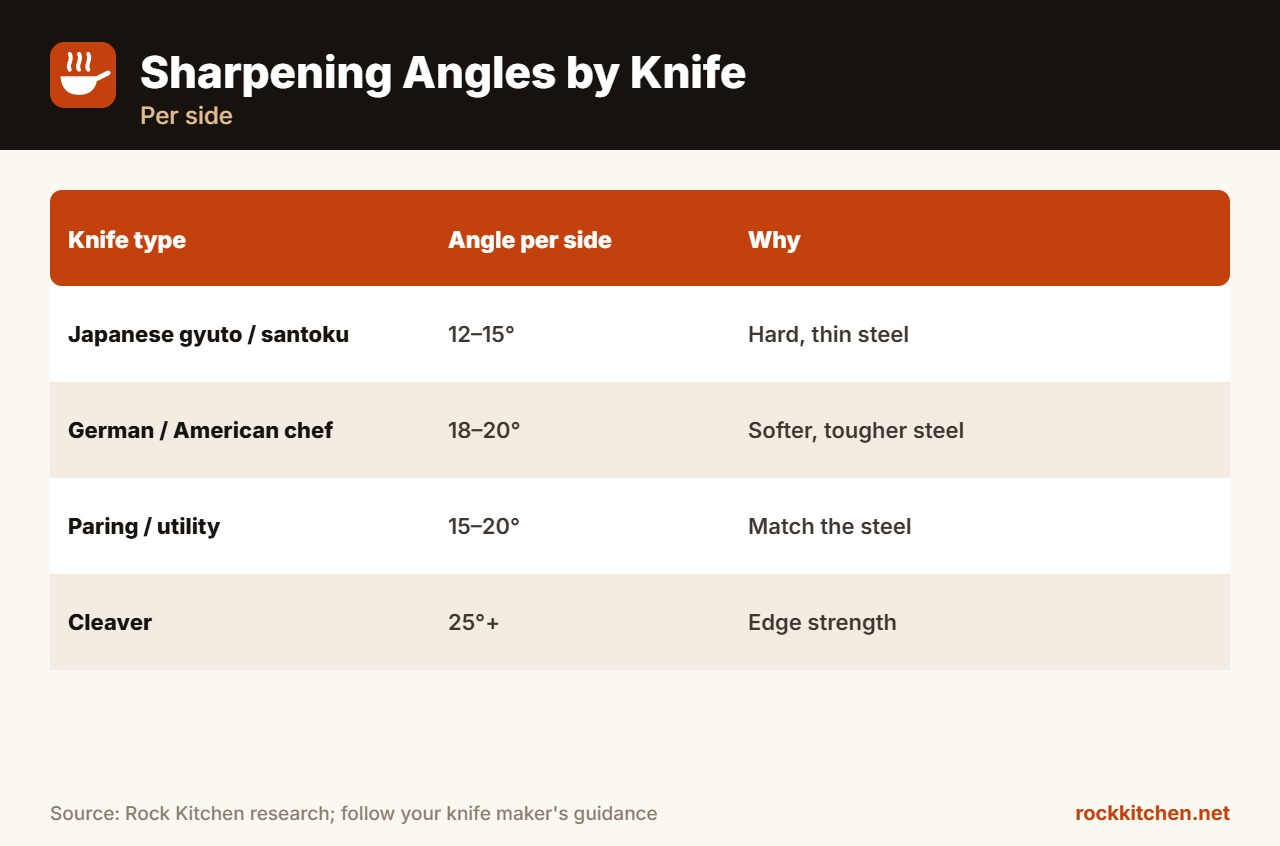
Western Knives: About 20°
German and American chef knives use softer, tougher steel. Around 20° per side keeps the edge from rolling.
Middle Ground: 17–18°
If you are unsure of the steel, 17–18° per side is a safe compromise for most kitchen knives.
Heavy Tasks: 25° or More
Cleavers and knives used on bone need a sturdier edge of 25° per side or higher.
Single-Bevel Knives
Yanagiba and deba knives are sharpened mostly on one side, following the existing bevel, with only a light back-side pass.
Per Side vs Inclusive
Most guides quote the angle per side. A 15° per side edge has a 30° inclusive angle; do not confuse the two when reading specs.
How to Check Your Angle
Color the edge bevel with a marker and make a few light strokes. If the ink disappears evenly from shoulder to edge, you are matching the existing angle. If it disappears only at the very edge, raise the spine slightly; if only at the shoulder, lower it.
Tips for Holding the Best Angle to Sharpen Kitchen Knives
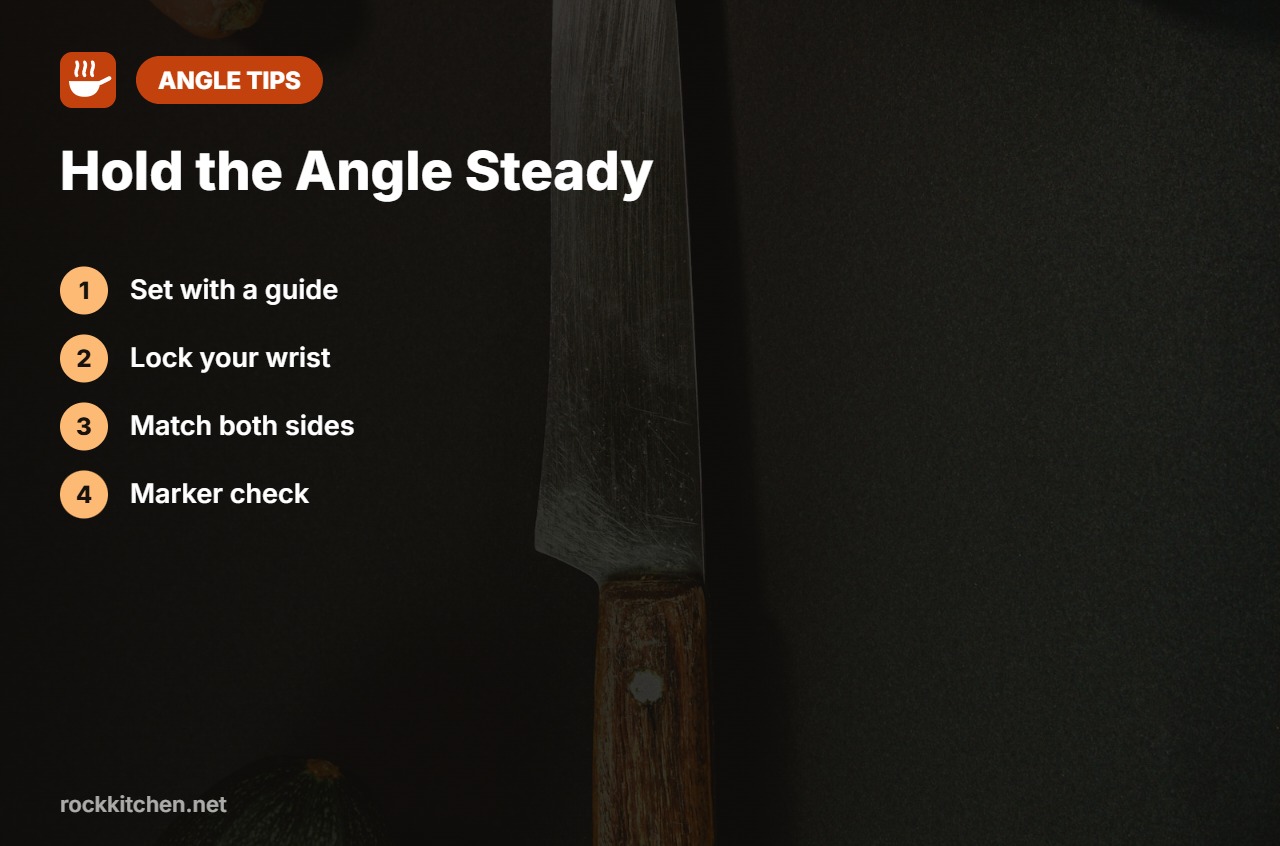
- Use a reference guide to set the angle before each set of strokes.
- Lock your wrist and move from the shoulder.
- Count strokes and match them on both sides.
- Use the marker trick to confirm you are hitting the edge.
- Finish with a few light, edge-trailing strokes.
Quick answers to common questions about sharpening angles.
Frequently Asked Questions
What is the best angle to sharpen kitchen knives?
About 15° per side for Japanese knives and about 20° for Western knives; 17–18° suits most mixed collections.
Is 15 or 20 degrees sharper?
15° feels sharper; 20° lasts longer on softer steel.
Can I change my knife’s angle?
Yes, but it takes time to reshape the bevel on a coarse stone.
Do I need an angle guide?
Not always, but guides help beginners learn consistency fast.
Final Verdict
The best angle to sharpen kitchen knives is about 15° for Japanese and 20° for Western knives. To hold it, start with the SHARPAL 196N or Wedgek wedges, or choose the Lansky Professional for a guided kit.
Related Guides
Keep building your sharpening setup with these guides:
- Best Japanese Whetstone for Beginners 2026: 6 Easy Starter Picks
- Best Strop for Kitchen Knives 2026: 6 Picks for Chef and Paring Knives
- How We Test and Research Kitchen Gear
- All Knife Sharpening Guides
Prices and availability change often. Check the current listing on Amazon before you buy.