
As an Amazon Associate we earn from qualifying purchases. Learn more about our affiliate disclaimer.
The best Japanese natural stone for beginners is hard enough that it stays flat, fine enough to finish a kitchen knife, and sold with honest information about where it was quarried. Natural Japanese stones (tennen toishi) are prized for the bright, toothy edge they leave, but each one is different, and many beginners waste money on a soft or inconsistent stone before they can hold a steady angle.
Genuine Japanese natural stones are rare on Amazon US. The most reliable option is the Tsushima “Ocean Blue” stone sold by MASUTA, so we compare its sizes, add a matching nagura, and include the synthetic stone you should learn on first.
Quick Answer: The Best Japanese Natural Stone for Beginners
- Best Overall for BeginnersMASUTA Japanese Natural Sharpening Honing Stone (L, Extra Hard)
- Best for Chef KnivesMASUTA Japanese Natural Sharpening Honing Stone (XXL)
- Best Add-OnMASUTA Natural Nagura Stone (12K, N70)
- Best Stone to Learn On FirstKING KW65 1000/6000 Grit Combination Whetstone with Base
- Best Non-Japanese AlternativeArdennes-Coticule Coticule Whetstone Small (ARD404)
The MASUTA L (H) extra-hard Tsushima stone is the best Japanese natural stone for beginners: it resists dishing and finishes kitchen knives well. Learn first on a King 1000/6000, then move to the natural stone.
Best Japanese Natural Stone for Beginners Comparison Table
| Product | Best For | Type | Key Feature | Buy |
|---|---|---|---|---|
| MASUTA Natural L (H) | Best Overall for Beginners | Japanese natural stone | Tsushima “Ocean Blue” stone, ~10–12K, extra hard | Check Price |
| MASUTA Natural XXL | Best for Chef Knives | Japanese natural stone | Wide 8 x 3.5 in. Tsushima stone, ~10–12K | Check Price |
| MASUTA Nagura | Best Add-On | Natural nagura stone | Tsushima nagura, ~12K, for slurry | Check Price |
| KING KW65 | Best Stone to Learn On First | Synthetic combination waterstone | 1000/6000 grit with plastic base | Check Price |
| Belgian Coticule | Best Non-Japanese Alternative | Belgian natural stone | Natural yellow coticule from the Belgian Ardennes | Check Price |
The 5 Best Japanese Natural Stones for Beginners
We ranked these by authenticity, hardness, size and how forgiving they are for a first natural stone.

1. MASUTA Japanese Natural Sharpening Honing Stone (L, Extra Hard)
1. Extra-hard Tsushima stone that stays flat while you learn.
👍 Pros & Cons
Pros
- Genuine Japanese natural stone with a stamp of authenticity
- Extra-hard grade resists dishing, which forgives beginner technique
- Usable size for kitchen knives
Cons
- A finishing stone only; you still need a medium synthetic stone first
- Limited stock and natural variation between stones
📄 Detailed Review
- Stone: Natural Tsushima “Ocean Blue”
- Size: 8.0 x 2.7 x 1.0 in. (200 x 70 x 25 mm)
- Grit: About #10–12K
- Hardness: Extra hard (H)
MASUTA sells stones quarried from a now-closed underwater mine near South Tsushima Island. This L (H) version is the extra-hard grade, which wears slowly and stays flat longer.
For a beginner it is the easiest way to try a real Japanese natural stone: use it after a 1000-grit synthetic, with water and a nagura to raise slurry.
2. MASUTA Japanese Natural Sharpening Honing Stone (XXL)
2. A wider 3.5 in. surface for long gyutos.
👍 Pros & Cons
Pros
- Wide surface suits chef knives and gyutos
- Hard, dense and fine for a polished edge
- Long lifetime at 1 in. thick
Cons
- Higher price than synthetic finishers
- Needs a lapping plate to keep flat
📄 Detailed Review
- Stone: Natural Tsushima “Ocean Blue”
- Size: 8.0 x 3.5 x 1.0 in. (200 x 90 x 25 mm)
- Weight: 2.8 lb
- Grit: About #10–12K
The XXL is the widest standard MASUTA stone, 3.5 in. across, which gives long kitchen blades plenty of room.
It produces a fine, slightly hazy natural-stone finish that many cooks find bites into tomatoes better than a mirror polish.

3. MASUTA Natural Nagura Stone (12K, N70)
3. A matching natural nagura for slurry.
👍 Pros & Cons
Pros
- Matches MASUTA finishing stones
- Speeds up cutting with a fine slurry
- Clears metal swarf from the stone
Cons
- Small; it is an accessory, not a sharpening stone
- Few ratings
📄 Detailed Review
- Stone: Natural Tsushima nagura
- Size: 2.7 x 1.2 x 1.2 in. (70 x 30 x 30 mm)
- Grit: About #12,000
- Use: Raises slurry, cleans the stone surface
A nagura is a small stone rubbed on the surface of a larger waterstone to build slurry. Natural stones cut much faster with slurry.
If you buy a natural finishing stone, a matching nagura is the simplest upgrade.

4. KING KW65 1000/6000 Grit Combination Whetstone with Base
4. The classic 1000/6000 synthetic to build your angle.
👍 Pros & Cons
Pros
- The classic Japanese starter stone
- Thousands of ratings
- Builds the skills you need before a natural stone
Cons
- Soaking stone
- Wears and dishes faster than hard stones
📄 Detailed Review
- Grits: 1000 / 6000
- Size: 8 x 2.5 x 1 in.
- Base: Plastic stand
- Made in: Japan
Most sharpeners learn on a 1000/6000 synthetic before buying a natural stone. The King KW65 is the most common choice.
Use the 1000 side to set the edge, then move to a natural finishing stone when your angle is consistent.

5. Ardennes-Coticule Coticule Whetstone Small (ARD404)
5. A small Belgian natural stone for paring knives.
👍 Pros & Cons
Pros
- Famous natural stone with a long history
- Fine edge with slurry or plain water
- Compact for paring and pocket knives
Cons
- Small size for chef knives
- Very few ratings on Amazon
📄 Detailed Review
- Stone: Natural Belgian coticule
- Size: About 4.5 x 2.5 in. (small)
- Use: Water, with or without slurry
- Origin: Ardennes, Belgium
Coticule is a natural garnet-bearing stone quarried in the Belgian Ardennes and prized by razor and knife sharpeners.
It is a good non-Japanese alternative if you want to experiment with natural stones on smaller blades.
How We Chose the Best Japanese Natural Stone for Beginners
To research the best Japanese natural stone for beginners, we compared stones and accessories sold on Amazon US by stone type (natural novaculite, Japanese or Belgian natural stone, or synthetic), stated grit or grade, size, lubricant (water or oil) and what is included. We then read patterns in verified-buyer reviews for cutting speed, edge finish, flatness, consistency between stones and how honestly each listing describes its origin.
Clean blades after sharpening and wash kitchen knives before they touch food again, following USDA Food Safety and Inspection Service cleanliness guidance. Our research method is on the How We Test page; this guide is based on specifications and buyer evidence, not lab testing.
Buying Guide: Choosing a First Japanese Natural Stone
Start With a Synthetic
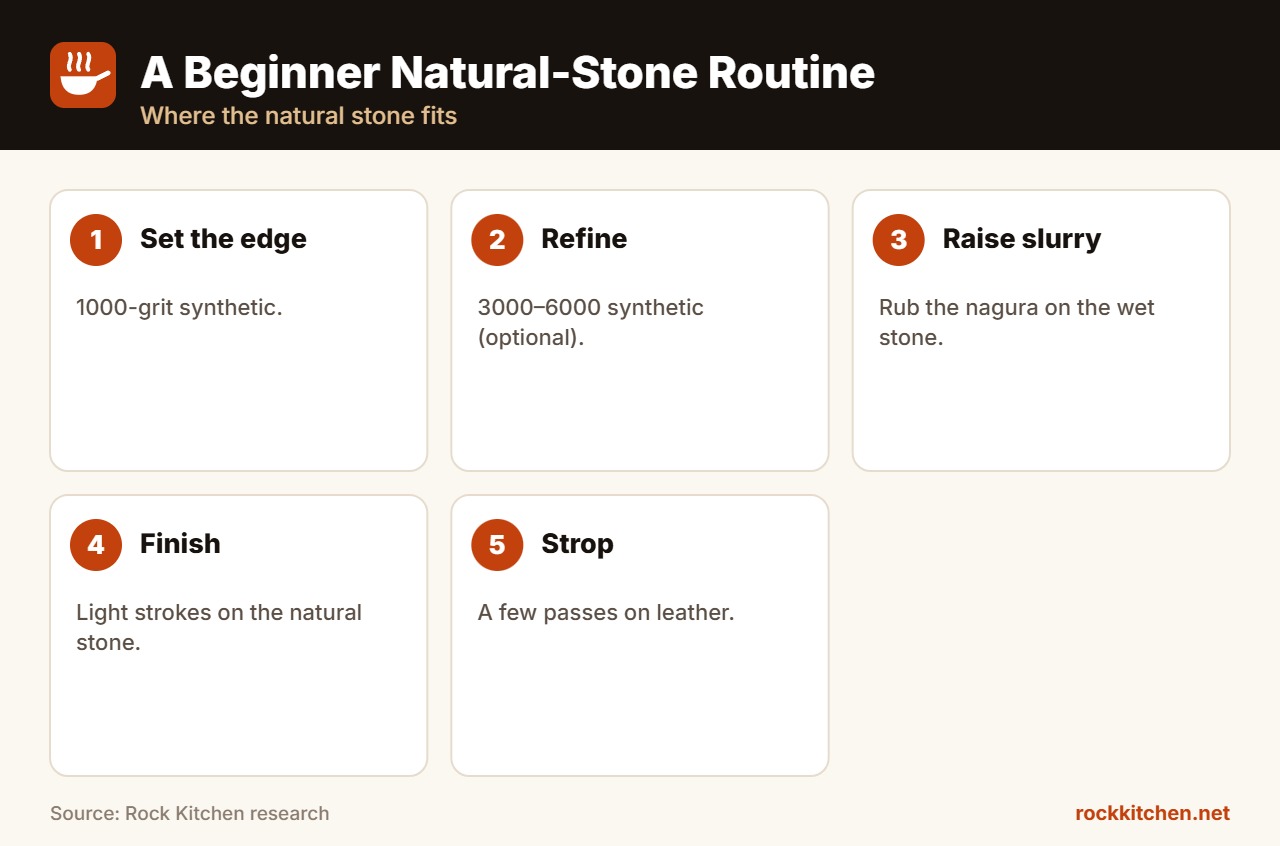
A natural stone is a finishing stone. Learn on a 1000-grit synthetic until you can raise and remove a burr, then add the natural stone for the final step.
Choose a Hard Stone
Hard natural stones wear slowly and stay flat. Soft stones release slurry quickly and cut faster but dish easily, which punishes beginner technique.
Buy Proven Origin
Look for a named mine or region and a seller stamp. Vague “natural stone” listings with no origin are often synthetic or reconstituted.
Size for Your Knives
A stone about 8 x 2.7 in. is enough for most kitchen knives; 3.5 in. wide is easier for tall chef knife blades.
Plan for Slurry and Lapping
Natural stones work best with a nagura to raise slurry, and every stone needs a flattening plate from time to time.
What to Expect From the Edge
A Japanese natural finisher usually leaves a fine, slightly misty edge rather than a mirror. Many cooks like it because it keeps a little bite for slicing tomatoes and onions, while still feeling smooth through herbs and fish.
Tips for Your First Natural Stone
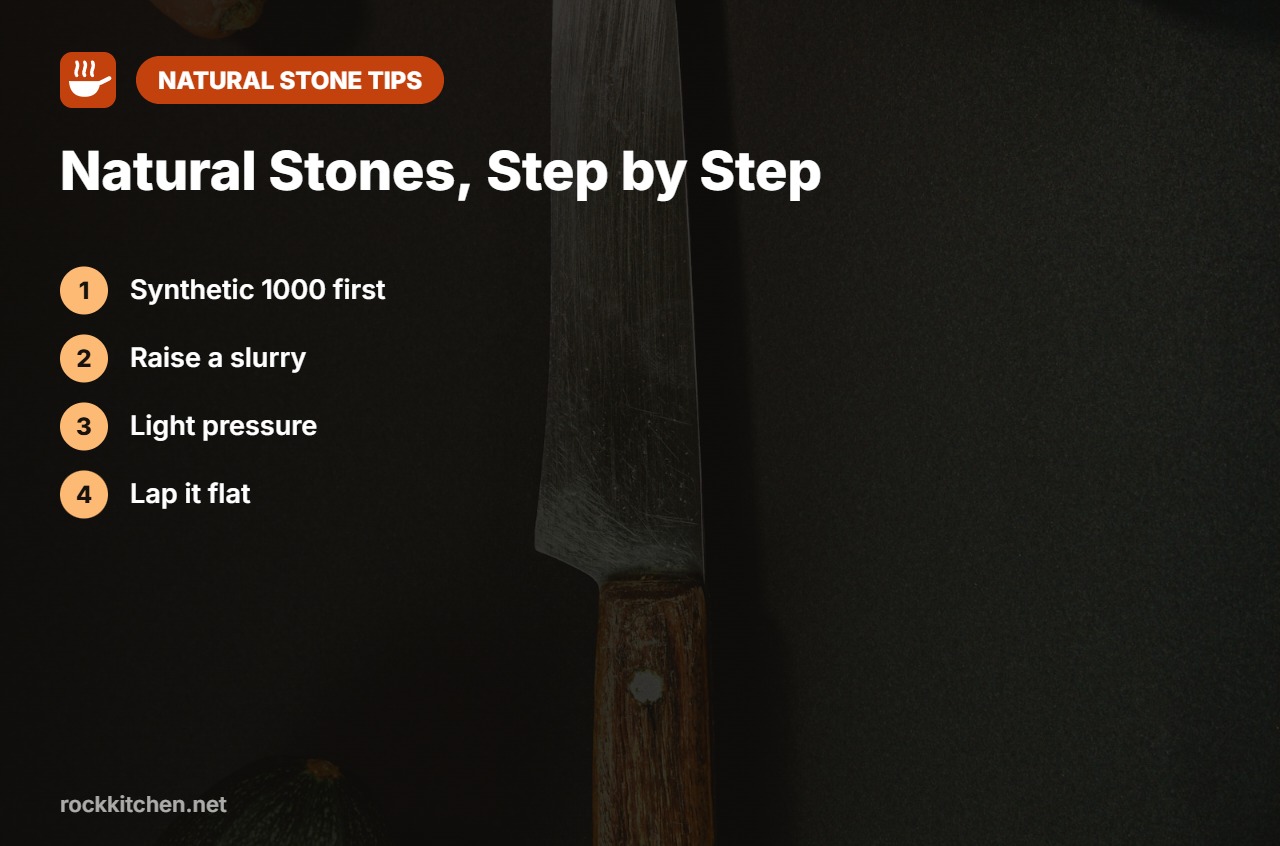
- Splash the stone with water instead of soaking it, unless the seller says otherwise.
- Use light pressure; natural stones reward patience.
- Keep the slurry on the stone; it does much of the cutting.
- Lap the stone flat before the first use.
- Let it dry slowly away from heat to avoid cracks.
Quick answers to the questions people ask before their first natural stone.
Frequently Asked Questions
What is the best Japanese natural stone for beginners?
The MASUTA L (H) extra-hard Tsushima stone is the best Japanese natural stone for beginners we found on Amazon.
Should a beginner start with a natural stone?
Start with a synthetic 1000 grit, then add a natural stone for finishing.
Do Japanese natural stones need soaking?
Most only need splashing; check the seller instructions.
Are natural stones better than synthetic?
Not always. They give a distinctive edge, but synthetic stones are more consistent.
Final Verdict
Our pick for the best Japanese natural stone for beginners is the MASUTA L (H). Choose the MASUTA XXL for chef knives, and learn first on the King KW65.
Related Guides
Keep building your sharpening setup with these guides:
- Best Japanese Whetstone for Beginners 2026: 6 Easy Starter Picks
- Best Japanese Finishing Stone 2026: 7 Picks from #5000 to #16000
- How We Test and Research Kitchen Gear
- All Knife Sharpening Guides
Prices and availability change often. Check the current listing on Amazon before you buy.