
As an Amazon Associate we earn from qualifying purchases. Learn more about our affiliate disclaimer.
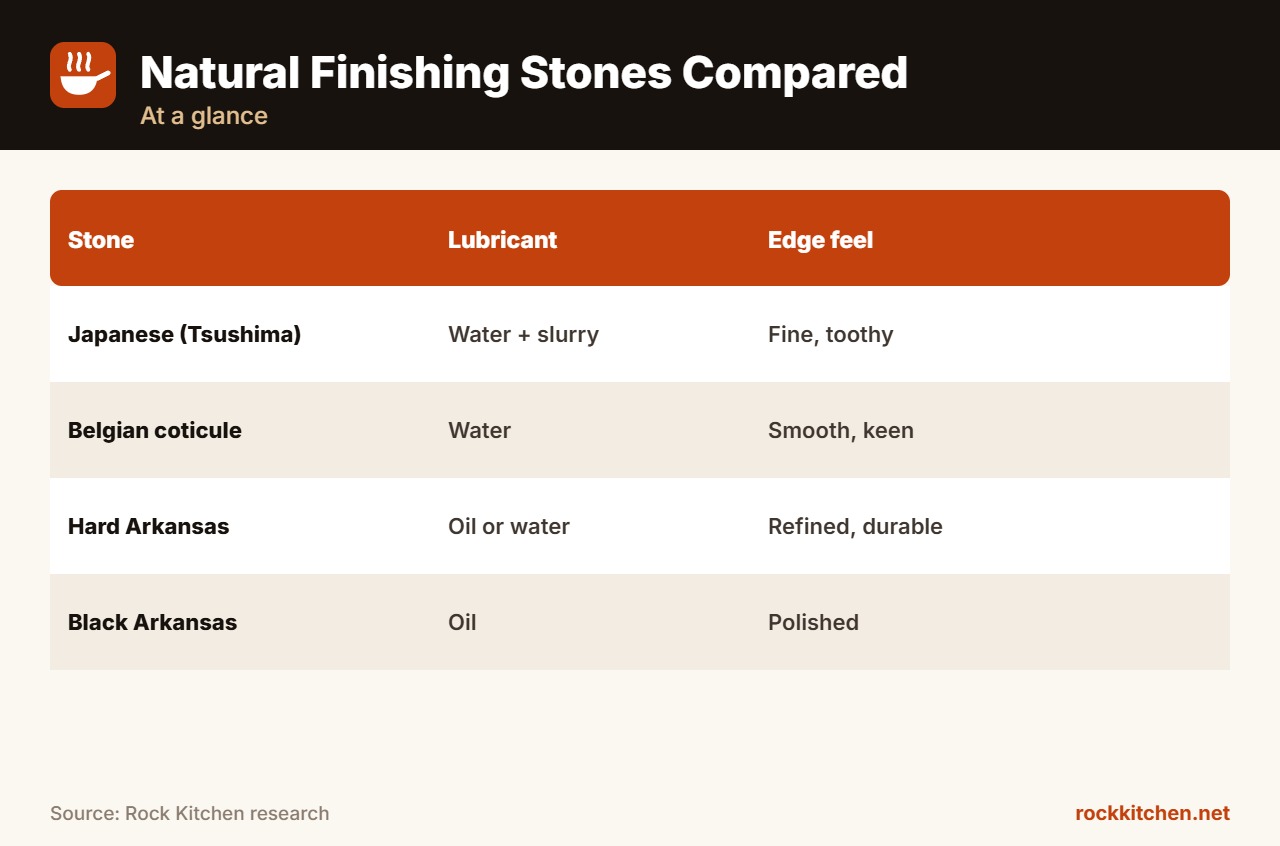
The best natural finishing stone gives your knife a refined edge with a character synthetic stones rarely match: a fine, slightly toothy bite from Japanese stones, a smooth keen edge from Belgian coticule, or a polished, durable finish from Hard and Black Arkansas novaculite. Natural finishers are the last step after a synthetic or medium stone has done the heavy work.
We compared six natural finishers available on Amazon from three stone families and explain which suits each knife and sharpener.

Quick Answer: The Best Natural Finishing Stone
- Best OverallMASUTA Japanese Natural Sharpening Honing Stone (XXL)
- Best Arkansas FinisherDan’s Genuine Arkansas Hard (Fine) Bench Stone 8 x 2 x 1/2 in. in Wood Box
- Best PolishBest Sharpening Stones Black Arkansas Stone, Wood Mounted 6 in.
- Best BelgianArdennes-Coticule Coticule Whetstone Small (ARD404)
- Best LargeMASUTA Japanese Natural Sharpening Honing Stone (3XL)
- Best BudgetSUWAJUME 10000 Grit Green Polishing Stone
The MASUTA XXL Tsushima stone is the best natural finishing stone for Japanese kitchen knives. For a durable American option, the Dan’s Hard Arkansas bench stone is the best natural finishing stone with oil.
Best Natural Finishing Stone Comparison Table
| Product | Best For | Type | Key Feature | Buy |
|---|---|---|---|---|
| MASUTA Natural XXL | Best Overall | Japanese natural stone | Wide 8 x 3.5 in. Tsushima stone, ~10–12K | Check Price |
| Dan’s Hard Arkansas 8 in. | Best Arkansas Finisher | Hard Arkansas bench stone | Fine novaculite, 8 x 2 in., wood box | Check Price |
| Black Arkansas 6 in. | Best Polish | Black Arkansas bench stone | Extra-fine black novaculite on wood base | Check Price |
| Belgian Coticule | Best Belgian | Belgian natural stone | Natural yellow coticule from the Belgian Ardennes | Check Price |
| MASUTA Natural 3XL | Best Large | Japanese natural stone | Extra-large 9 x 4 in. natural stone | Check Price |
| SUWAJUME 10K Green | Best Budget | Fine polishing stone | 10000 grit, 7 x 2.3 x 1.2 in. | Check Price |
The 6 Best Natural Finishing Stones
Ranked by authenticity, fineness, size and buyer feedback.

1. MASUTA Japanese Natural Sharpening Honing Stone (XXL)
1. Wide Tsushima stone at about 10–12K for a fine Japanese finish.
👍 Pros & Cons
Pros
- Wide surface suits chef knives and gyutos
- Hard, dense and fine for a polished edge
- Long lifetime at 1 in. thick
Cons
- Higher price than synthetic finishers
- Needs a lapping plate to keep flat
📄 Detailed Review
- Stone: Natural Tsushima “Ocean Blue”
- Size: 8.0 x 3.5 x 1.0 in. (200 x 90 x 25 mm)
- Weight: 2.8 lb
- Grit: About #10–12K
The XXL is the widest standard MASUTA stone, 3.5 in. across, which gives long kitchen blades plenty of room.
It produces a fine, slightly hazy natural-stone finish that many cooks find bites into tomatoes better than a mirror polish.

2. Dan’s Genuine Arkansas Hard (Fine) Bench Stone 8 x 2 x 1/2 in. in Wood Box
2. Fine novaculite bench stone from the Ouachita Mountains.
👍 Pros & Cons
Pros
- Quarried and finished by a long-running Arkansas maker
- Full bench size for kitchen knives
- Polished, durable edge
Cons
- Slow on dull knives
- Needs oil or water and occasional cleaning
📄 Detailed Review
- Stone: Hard Arkansas novaculite (fine)
- Size: 8 x 2 x 1/2 in.
- Origin: Ouachita Mountains, Arkansas
- Storage: Fitted wood box
Dan’s Whetstone quarries its own novaculite in the Ouachita Mountains. The Hard grade is the fine stone most people use to refine and maintain an edge.
At 8 x 2 in. it is big enough for chef knives, and the wood box protects it.

3. Best Sharpening Stones Black Arkansas Stone, Wood Mounted 6 in.
3. Black Arkansas for a near-mirror edge.
👍 Pros & Cons
Pros
- Bench-size Black Arkansas
- Wood mount keeps it steady
- Also available up to 10 in.
Cons
- Few ratings
- Slow, polishing only
📄 Detailed Review
- Stone: Black Arkansas novaculite
- Size: 6 x 2 x 1/2 in.
- Mount: Wood base
- Origin: Arkansas, USA
Black Arkansas is the finest natural Arkansas grade. This version is mounted on wood for bench use.
Choose a longer size if you finish chef knives on it.

4. Ardennes-Coticule Coticule Whetstone Small (ARD404)
4. Natural coticule for a smooth, keen edge.
👍 Pros & Cons
Pros
- Famous natural stone with a long history
- Fine edge with slurry or plain water
- Compact for paring and pocket knives
Cons
- Small size for chef knives
- Very few ratings on Amazon
📄 Detailed Review
- Stone: Natural Belgian coticule
- Size: About 4.5 x 2.5 in. (small)
- Use: Water, with or without slurry
- Origin: Ardennes, Belgium
Coticule is a natural garnet-bearing stone quarried in the Belgian Ardennes and prized by razor and knife sharpeners.
It is a good non-Japanese alternative if you want to experiment with natural stones on smaller blades.
5. MASUTA Japanese Natural Sharpening Honing Stone (3XL)
5. A huge 9 x 4 in. natural finisher for long slicers.
👍 Pros & Cons
Pros
- Largest MASUTA size for long slicers
- Very thick for years of use
- Stable on the bench
Cons
- Expensive and heavy
- Overkill for small knives
📄 Detailed Review
- Stone: Natural Tsushima “Ocean Blue”
- Size: 9.0 x 4.0 x 1.3 in. (230 x 100 x 35 mm)
- Weight: 5.0 lb
- Grit: About #10–12K
The 3XL is a large, thick block meant as a lifetime finishing stone.
Choose it if you sharpen long gyutos or sujihikis and want one natural finisher that will outlast many synthetics.

6. SUWAJUME 10000 Grit Green Polishing Stone
6. Low-cost 10K green polishing stone; origin details are thin.
👍 Pros & Cons
Pros
- Low price for a 10K finisher
- Can be used with water or oil
- Hundreds of ratings
Cons
- Seller describes it as natural, but origin details are thin
- Polishing only, not for dull knives
📄 Detailed Review
- Grit: #10000
- Size: 7.1 x 2.4 x 1.2 in.
- Use: Water or oil
- Weight: 2 lb
This green stone is marketed as natural and rated at 10000 grit. The listing gives few details about where it is quarried, so treat the natural claim with caution.
As a cheap final polish it gets good buyer feedback.
How We Chose the Best Natural Finishing Stone
To research the best natural finishing stone, we compared stones and accessories sold on Amazon US by stone type (natural novaculite, Japanese or Belgian natural stone, or synthetic), stated grit or grade, size, lubricant (water or oil) and what is included. We then read patterns in verified-buyer reviews for cutting speed, edge finish, flatness, consistency between stones and how honestly each listing describes its origin.
Clean blades after sharpening and wash kitchen knives before they touch food again, following USDA Food Safety and Inspection Service cleanliness guidance. Our research method is on the How We Test page; this guide is based on specifications and buyer evidence, not lab testing.
Buying Guide: How to Choose the Best Natural Finishing Stone
Japanese Natural Stones
Fine, often used with water and slurry. They leave a refined but slightly toothy edge that slices food well.
Belgian Coticule
A garnet-bearing natural stone famous among razor users. Slurry speeds it up; plain water gives a finer finish.
Hard and Black Arkansas
Dense novaculite used with oil. Hard refines; Black polishes. Very durable and slow to wear.
Size
An 8 in. long stone suits most kitchen knives. Small coticules and pocket stones are better for paring knives.
Edge Goals
A toothy edge bites tomatoes; a polished edge glides through fish and herbs. Choose the stone that matches how you cook.
Tips for Using a Natural Finishing Stone
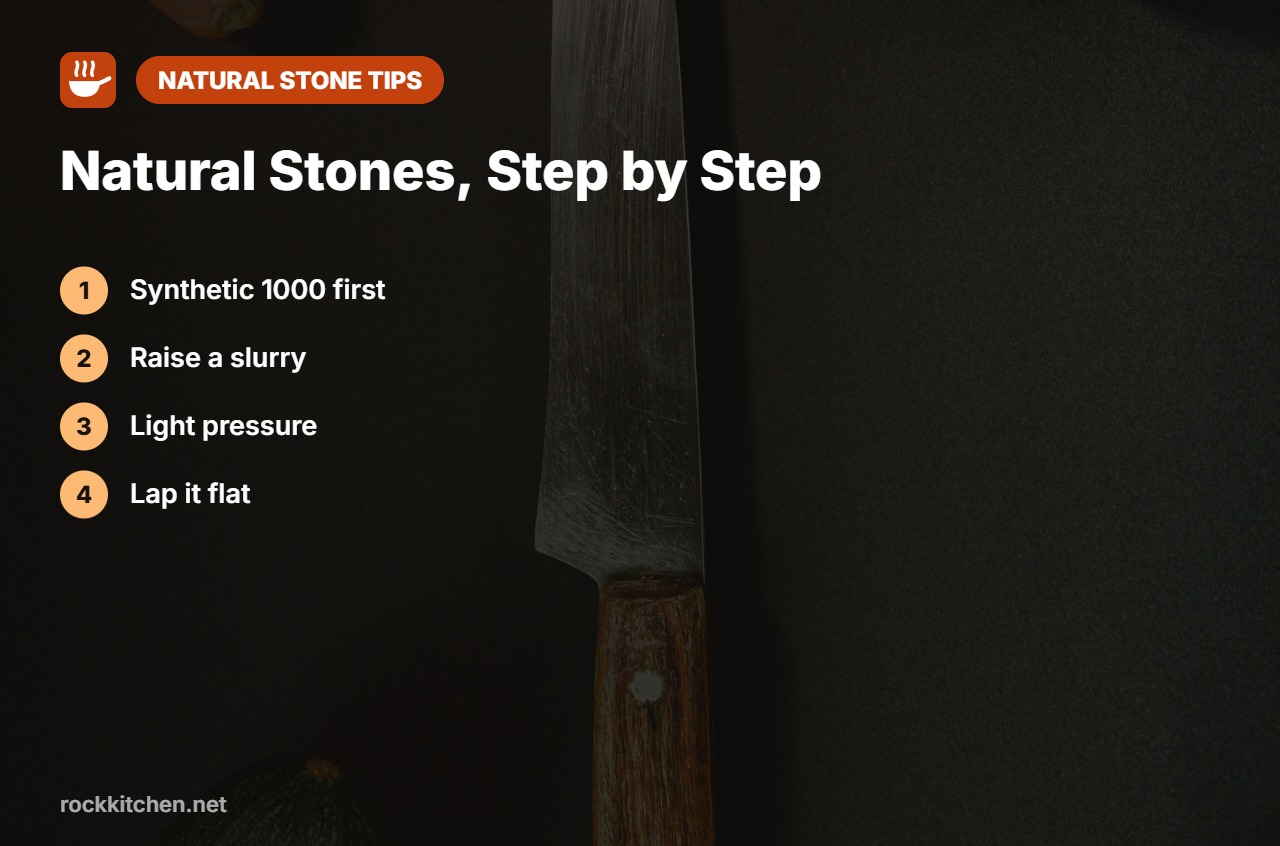
- Finish with very light pressure and edge-trailing strokes at the end.
- Use slurry on Japanese stones for speed, clean water for the last passes.
- Keep oil stones and waterstones separate.
- Lap the stone flat every few sessions.
- Strop lightly after finishing.
Quick answers to common questions about best natural finishing stone.
Frequently Asked Questions
What is the best natural finishing stone?
The MASUTA XXL Tsushima stone is the best natural finishing stone for Japanese knives; Dan’s Hard Arkansas is the best oil-based choice.
What grit is a natural finishing stone?
Most are roughly equivalent to 6000–12000 synthetic grit, but natural stones vary.
Can I use oil on a Japanese natural stone?
No. Use water on Japanese stones and oil or water on Arkansas stones.
Do I need a natural finisher?
No, but many sharpeners prefer the edge it leaves.
Final Verdict
Our pick for the best natural finishing stone is the MASUTA XXL. Choose Dan’s Hard Arkansas for an oil stone, or Black Arkansas for a polish.
Related Guides
Keep building your sharpening setup with these guides:
- Best Japanese Finishing Stone 2026: 7 Picks from #5000 to #16000
- Best 8000 Grit Whetstone 2026: 7 Polishing Stones for Mirror Edges
- How We Test and Research Kitchen Gear
- All Knife Sharpening Guides
Prices and availability change often. Check the current listing on Amazon before you buy.