

As an Amazon Associate we earn from qualifying purchases. Learn more about our affiliate disclaimer.
The best Shapton Glass Stone for most cooks is the #1000, the core of a fast, hard and long-wearing sharpening kit. Shapton GlassStones are thin ceramic stones on a glass backing that need no soaking, cut quickly and stay flat longer than most waterstones.
We compared seven GlassStone grits from #320 to #16000 by micron class and role, and suggest simple kits so you only buy the stones you need.
Quick Answer: The Best Shapton Glass Stone
- Best OverallShapton GlassStone #1000 (11 micron)
- Best FinisherShapton GlassStone #4000 (3 micron)
- Best Fine FinishShapton GlassStone #6000 (2 micron)
- Best for RepairShapton GlassStone #320 (40 micron)
- Best MiddleShapton GlassStone #2000 (6 micron)
- Best PolishShapton GlassStone #8000 (1 micron)
- Best Ultra-FineShapton GlassStone #16000 (Nano class)
The #1000 is the best Shapton Glass Stone to start with. Add the #4000 or #6000 for finishing, the #320 for repairs and the #8000 for a polished edge.
Best Shapton Glass Stone Comparison Table
| Product | Best For | Type | Key Feature | Buy |
|---|---|---|---|---|
| GlassStone 1000 | Best Overall | Glass-backed stone | #1000, 11 µm, 8.25 x 2.75 in. | Check Price |
| GlassStone 4000 | Best Finisher | Glass-backed stone | #4000, 3 µm class | Check Price |
| GlassStone 6000 | Best Fine Finish | Glass-backed stone | #6000, 2 µm class | Check Price |
| GlassStone 320 | Best for Repair | Glass-backed stone | #320, 40 µm, no soaking | Check Price |
| GlassStone 2000 | Best Middle | Glass-backed stone | #2000, 6 µm class | Check Price |
| GlassStone 8000 | Best Polish | Glass-backed stone | #8000, 1 µm class | Check Price |
| GlassStone 16000 | Best Ultra-Fine | Glass-backed stone | #16000, nano class | Check Price |
The 7 Best Shapton Glass Stones
Each grit has a clear job, so the best Shapton Glass Stone for you depends on your kit.

1. Shapton GlassStone #1000 (11 micron)
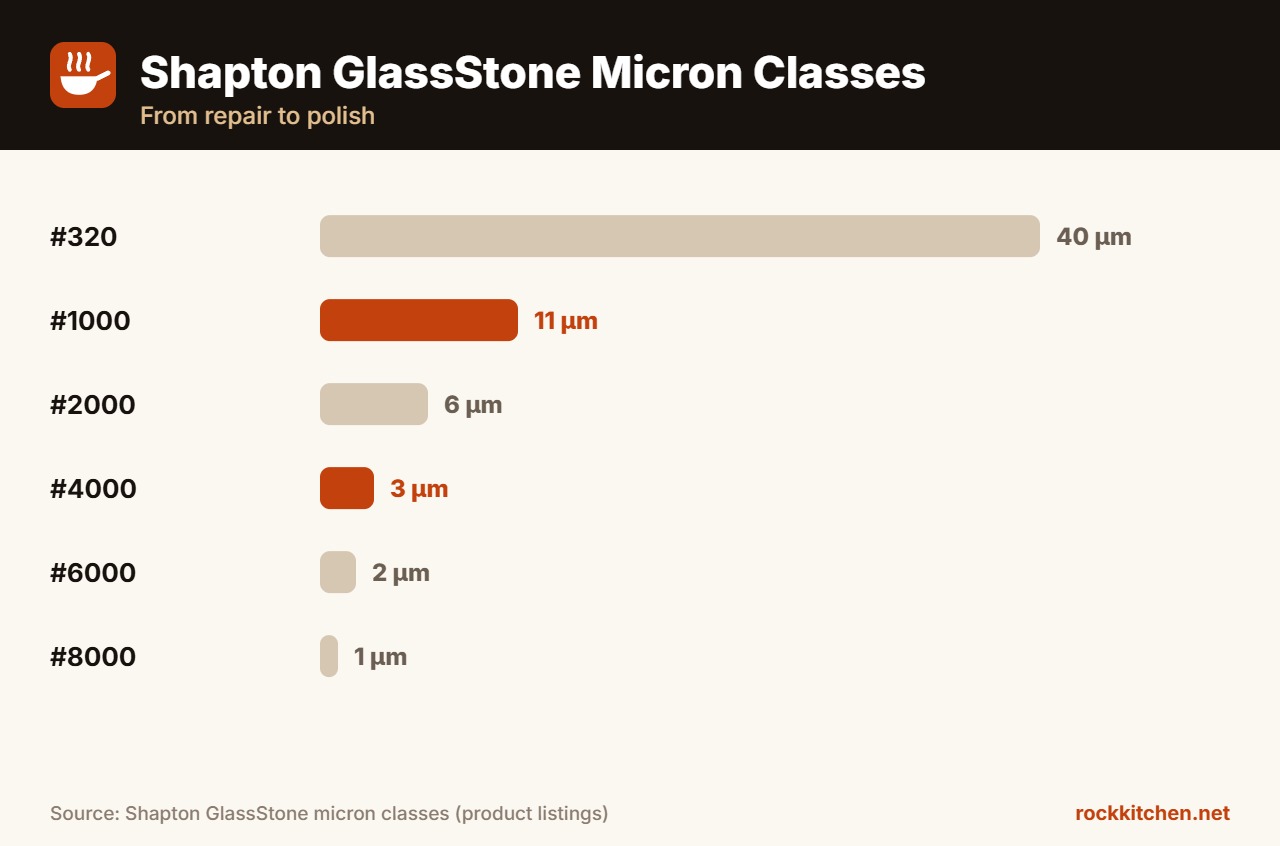
1. The #1000 (11 µm class) is the core sharpening stone. It is the best Shapton Glass Stone to buy first.
👍 Pros & Cons
Pros
- Splash-and-go convenience
- Long-lasting abrasive
- Glass backing keeps it usable when thin
Cons
- Hard feel takes getting used to
- Higher cost than Kuromaku #1000
📄 Detailed Review
- Grit: #1000 (11 micron class)
- Size: 8.25 x 2.75 in.
- Soaking: No need to soak
- Wear: Lasts longer than typical waterstones
Shapton’s GlassStone #1000 is in the 11 micron class, measures 8.25 x 2.75 inches and needs no soaking.
It is the most popular GlassStone grit and a good first stone in the series.

2. Shapton GlassStone #4000 (3 micron)
2. #4000 (3 µm class) for a keen, refined edge after #1000.
👍 Pros & Cons
Pros
- Excellent first finishing grit
- Glass base stays flat
Cons
- Premium price
📄 Detailed Review
- Grit: #4000 (3 micron class)
- Material: Glass backing with ceramic abrasive
- Finish: Ultra fine
The #4000 GlassStone is a 3 micron class stone described as ultra fine, on Shapton’s glass backing.
For kitchen knives it is a finishing stone that keeps some bite.

3. Shapton GlassStone #6000 (2 micron)
3. #6000 (2 µm class) for a smooth, refined kitchen edge.
👍 Pros & Cons
Pros
- Polished edge on Japanese knives
- No soaking
Cons
- Little stock information
📄 Detailed Review
- Grit: #6000 (2 micron class)
- Size: 2.75 x 8.25 in.
The #6000 GlassStone sits in the 2 micron class and measures 2.75 x 8.25 inches.
It is a classic final stone for gyuto and santoku edges.

4. Shapton GlassStone #320 (40 micron)
4. #320 (40 µm class) for chips and reprofiling.
👍 Pros & Cons
Pros
- Fast cutting coarse stone
- Ready in seconds, no soaking
- Low wear
Cons
- Premium price for a coarse stone
📄 Detailed Review
- Grit: #320 (40 micron class)
- Soaking: Not needed, spray and go
- Binder: Long-wearing Shapton binder
- Package: 21.2 x 7.6 x 2 cm
The #320 GlassStone is rated in the 40 micron class. Shapton says GlassStones need no soaking, wear slowly thanks to their binder and cut quickly because of high abrasive content.
Use it for repairs and reprofiling.

5. Shapton GlassStone #2000 (6 micron)
5. #2000 (6 µm class) for a toothy edge or a smoother jump.
👍 Pros & Cons
Pros
- Smooth step after #1000
- No soaking
Cons
- Fewer details in the listing
📄 Detailed Review
- Grit: #2000 (6 micron class)
- Type: WA
- Soaking: Not needed
The #2000 GlassStone sits in the 6 micron class. It bridges #1000 and #4000 for a refined working edge.
Use it if you want a slightly cleaner edge than #1000 without going to polish.

6. Shapton GlassStone #8000 (1 micron)
6. #8000 (1 µm class) for a polished edge.
👍 Pros & Cons
Pros
- Fine polish with no soaking
- Stays flat on glass backing
Cons
- Overkill for soft stainless knives
📄 Detailed Review
- Grit: #8000 (1 micron class)
- Size: 2.75 x 8.25 in.
The #8000 GlassStone is in the 1 micron class. It is a high-polish stone that works straight from a spray of water.
Choose it as the last step for single-bevel and hard-steel knives.

7. Shapton GlassStone #16000 (Nano class)
7. #16000 (nano class) for enthusiasts chasing a mirror.
👍 Pros & Cons
Pros
- Mirror finishing
- Uniform particle size
Cons
- Specialist and expensive
- Small gain for most cooks
📄 Detailed Review
- Grit: #16000 (nano class)
- Abrasive: Very dense, uniform particles
- Type: CA
The #16000 GlassStone is a nano-class stone with very dense, uniform abrasive particles.
It is for enthusiasts chasing a mirror edge on straight razors or single-bevel knives.
How We Chose the Best Shapton Glass Stone
To choose the best Shapton Glass Stone, we compared micron class, role and owner feedback on speed, feel, loading and wear across the GlassStone range. We also looked at price per millimetre of usable stone, the quality of included holders and how clearly each maker explains soaking, flattening and care, since those details shape how pleasant a stone is to use week after week.
Wash your knife and board after sharpening, following USDA Food Safety and Inspection Service cleanliness guidance. Our method is on the How We Test page.
Buying Guide: How to Choose the Best Shapton Glass Stone
Why GlassStones?
They need no soaking, cut fast, wear slowly and stay flat, which suits busy cooks. The hard binder also gives clear feedback, so you can hear and feel when the bevel sits flat on the stone.
Two-Stone Kit
#1000 plus #4000 or #6000 covers sharpening and finishing for most kitchens. Many sharpeners find #4000 more forgiving for everyday knives, while #6000 suits harder Japanese steels.
Three-Stone Kit
Add #320 for repairs, or #8000 for a polished edge. Buy the extra grits only once you know you need them; a good #1000 and finisher handle most kitchen knives.
Thin Stones
GlassStones are thin, so they wear out sooner than thick stones; light pressure helps them last. A holder or the stone’s case keeps it stable, and steady, even strokes spread the wear across the whole surface.
Flatten Gently
They dish slowly, but flatten with a fine diamond plate when needed. Over-flattening wastes stone, so check with a pencil grid and stop when the lines are gone.
Tips for Shapton GlassStones
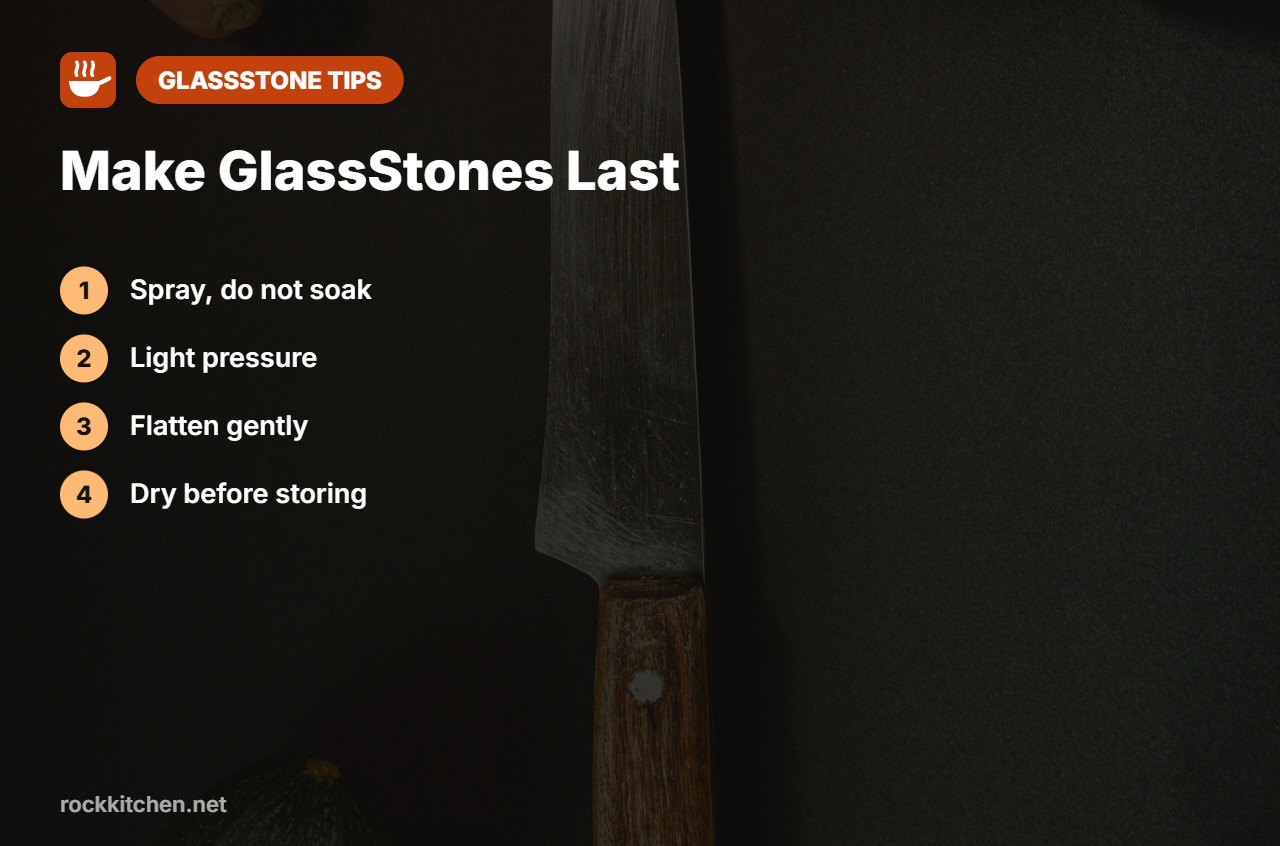
- Spray the surface with water; never soak.
- Use light pressure to protect the thin stone.
- Rinse the knife between grits.
- Flatten with a fine diamond plate.
- Dry the stone before closing its case.
Common questions about the best Shapton Glass Stone.
Frequently Asked Questions
What is the best Shapton Glass Stone to buy first?
The #1000 is the best Shapton Glass Stone to start with because it does most of the sharpening.
Do GlassStones need soaking?
No. Spray water on the surface before use.
GlassStone or Kuromaku?
GlassStones are harder and thinner; Kuromaku stones are thicker and more forgiving.
Is #16000 worth it?
Only for enthusiasts chasing a mirror finish.
Final Verdict
Our final pick for the best Shapton Glass Stone is the GlassStone #1000. Add the #4000 or #6000 for finishing.
Related Guides
Keep building your sharpening setup with these guides:
- Best Shapton Whetstone 2026
- Best 8000 Grit Whetstone 2026
- Best Splash and Go Whetstone 2026
- How We Test and Research Kitchen Gear
- All Knife Sharpening Guides
Prices and availability change often. Check the current listing on Amazon before you buy.