
As an Amazon Associate we earn from qualifying purchases. Learn more about our affiliate disclaimer.
The best coarse diamond plate removes steel fast enough to fix chips, reset a bevel or flatten a dished waterstone in minutes. Coarse diamond, roughly 80 to 400 grit, is the repair tool of a sharpening kit, not the finishing step.
We compared six coarse plates from Atoma, DMT, SHARPAL and S SATC by grit in microns, plate size and best use, so you can pick one that matches the damage on your knives.
Quick Answer: The Best Coarse Diamond Plate
- Best OverallDMT D8C Dia-Sharp 8-Inch Coarse Bench Stone
- Best for FlatteningAtoma #140 Coarse Diamond Sharpener
- Best Heavy RepairDMT D8XX Dia-Sharp Extra-Extra-Coarse Plate
- Best Two-GritSHARPAL 169H Large 220/600 Diamond Stone
- Best BudgetS SATC 150/600 Double-Sided Diamond Plate, 8 in.
- Best for HoldersSHARPAL 2-Piece 80/325 Diamond Plates (1 x 6 in.)
The DMT D8C is the best coarse diamond plate for most kitchens (45 µm, continuous surface). Choose the Atoma #140 or DMT D8XX for heavy repair and flattening.
Best Coarse Diamond Plate Comparison Table
| Product | Best For | Type | Key Feature | Buy |
|---|---|---|---|---|
| DMT D8C (Coarse) | Best Overall | Diamond bench stone | Continuous coarse diamond, made in USA | Check Price |
| Atoma #140 | Best for Flattening | Diamond plate | #140 coarse diamond for reshaping and lapping | Check Price |
| DMT D8XX | Best Heavy Repair | Diamond bench stone | 120 micron / 120 mesh extra-extra-coarse | Check Price |
| SHARPAL 169H | Best Two-Grit | Two-sided diamond plate | 220 (60 µm) / 600 (25 µm), 8 x 3 in. | Check Price |
| S SATC 150/600 | Best Budget | Two-sided diamond plate | 150 / 600 grit coarse combination | Check Price |
| SHARPAL 80/325 plates | Best for Holders | Diamond plates for holders | 80 grit (180 µm) + 325 grit (45 µm) | Check Price |
The 6 Best Coarse Diamond Plates
The best coarse diamond plate for you depends on how much steel you need to remove.

1. DMT D8C Dia-Sharp 8-Inch Coarse Bench Stone
1. A 45 µm continuous coarse surface that repairs dull edges and stays flat. It is the best coarse diamond plate for most cooks.
👍 Pros & Cons
Pros
- Continuous surface works for pointed tips and small tools
- Sharpen dry or with water, no messy oil
- Designed not to hollow or groove
Cons
- Coarse grit needs a finer stone afterwards
- Diamond surfaces feel aggressive for the first few uses
📄 Detailed Review
- Surface: Continuous coarse monocrystalline diamond
- Length: 8 in.
- Base: 4 non-skid rubber feet
- Use: Dry or with water, no oil
- Origin: Made in USA
The D8C is DMT’s 8-inch coarse Dia-Sharp: a continuous (no polka-dot) diamond surface on a plate with rubber feet. It is built to repair dull and damaged edges quickly and to work dry or with water.
In a kitchen it is the “reset” stone: use it when an edge is badly rolled or chipped, then move to a fine stone. Because it stays flat, it can also level waterstones.
2. Atoma #140 Coarse Diamond Sharpener
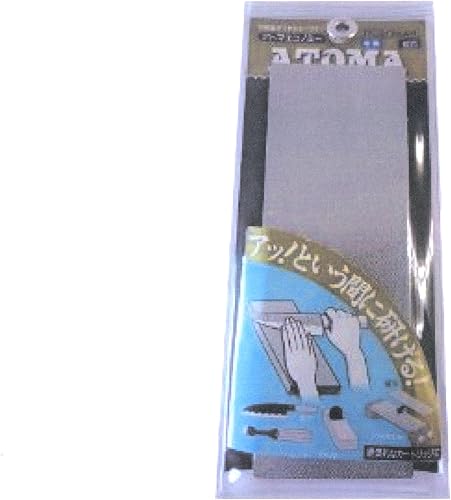
2. Very coarse #140 that flattens coarse stones and removes chips quickly.
👍 Pros & Cons
Pros
- Very fast metal removal for chipped or neglected edges
- Coarse enough to flatten dished coarse and medium whetstones quickly
- Diamond surface does not wear hollow like a soft stone
Cons
- Far too aggressive for routine kitchen-knife touch-ups
- Leaves a deep scratch pattern that needs a medium stone to refine
📄 Detailed Review
- Brand: Atoma (Tsuboman, Japan)
- Grit: #140 coarse
- Abrasive: Diamond
- Use: Edge repair, flattening coarse stones
The #140 is the roughest grade in the Atoma line, and it is the plate people reach for when an edge needs real repair: a chipped heel, a broken tip or a bevel that has been ground at the wrong angle for years. It also works as a heavy lapping plate for coarse waterstones that have dished badly.
For a kitchen setup, think of it as a specialist. Most cooks will only need it a few times a year, and they should always follow it with a #400–#1000 surface before the finishing stone.

3. DMT D8XX Dia-Sharp Extra-Extra-Coarse Plate
3. 120 µm for reprofiling, flattening and tool backs.
👍 Pros & Cons
Pros
- Fastest DMT bench surface for repair work
- Listed for flattening conventional and water stones
- Grit clearly marked on the base
Cons
- Much too coarse for normal knife sharpening
- Needs several follow-up grits to refine
📄 Detailed Review
- Grit: Extra-extra-coarse (120 micron / 120 mesh)
- Length: 8 in.
- Uses: Edge repair, flattening stones, plane soles, chisel backs
- Base: Non-skid rubber feet
At 120 micron (120 mesh), the D8XX is the roughest plate in the Dia-Sharp line. DMT lists it for quickly repairing edges and for flattening plane soles, chisel backs and conventional or water stones.
For kitchen knives it is strictly a repair tool. Its real value is as a long-lasting flattening plate for coarse stones.

4. SHARPAL 169H Large 220/600 Diamond Stone
4. Extra-coarse 220 (60 µm) plus fine 600 (25 µm) on one 8 x 3 in. plate.
👍 Pros & Cons
Pros
- 220 side repairs severely damaged edges
- 600 side refines straight after repair
- Large, stable surface
Cons
- Coarser than most cooks need day to day
- Needs a finer stone for a polished edge
📄 Detailed Review
- Grits: Extra-coarse 220 (60 µm) / Fine 600 (25 µm)
- Size: 8 x 3 in.
- Steels: Hard steels incl. CPM-series, M390, Elmax
- Uses: Knives, chisels, plane blades
The 169H pairs extra-coarse 220 grit (60 micron) with fine 600 grit (25 micron). SHARPAL lists the 220 side for severely damaged edges.
It is a strong choice for a coarse plate in a kitchen kit, especially if you inherit neglected knives or sharpen for friends.

5. S SATC 150/600 Double-Sided Diamond Plate, 8 in.
5. An 8 in. 150/600 plate that never needs flattening.
👍 Pros & Cons
Pros
- Coarse 150 side for fast repairs
- 600 side cleans up the scratches
- Affordable coarse option
Cons
- Smaller owner base than SATC 400/1000
- Not a finishing tool
📄 Detailed Review
- Grits: 150 / 600
- Length: 8 in.
- Construction: Electroplated monocrystalline diamond on steel
- Maintenance: Does not need flattening
The 150/600 version swaps in a much coarser 150 grit side for repair and flattening jobs, with 600 grit to refine.
It is a budget-friendly way to add a coarse diamond surface to a whetstone kit.

6. SHARPAL 2-Piece 80/325 Diamond Plates (1 x 6 in.)
6. An 80/325 1 x 6 in. bar for guided sharpening systems.
👍 Pros & Cons
Pros
- Extremely coarse 80 grit for reprofiling
- Fits guided sharpening systems
- Pairs with 325 to restore after repair
Cons
- Narrow format, needs a holder or guided system
- Overkill for routine sharpening
📄 Detailed Review
- Grits: 80 (180 µm) / 325 (45 µm)
- Format: 1 x 6 in. with beveled ends
- Fits: SHARPAL Universal Stone Holder and similar
- Abrasive: Electroplated monocrystalline diamond
These 1 by 6 inch plates are made for guided sharpeners and 1×6 holders. The 80 grit (180 micron) plate is for reprofiling and repairing very dull edges; the 325 grit (45 micron) plate restores the edge afterwards.
They are a niche but powerful option for anyone who already uses a guided system.
How We Chose the Best Coarse Diamond Plate
To pick the best coarse diamond plate, we compared grit in microns, surface type, plate length and listed uses, then read owner reports on cutting speed, scratch depth and break-in.
Coarse plates rely on industrial diamond, described in the U.S. Geological Survey industrial diamond data. Wash knives after sharpening as advised in USDA Food Safety and Inspection Service cleanliness guidance. Our method is on the How We Test page.
Buying Guide: How to Choose the Best Coarse Diamond Plate
How Coarse Is Coarse?
80–150 grit is for heavy repair and flattening; 220–400 grit is for routine reprofiling and dull edges.
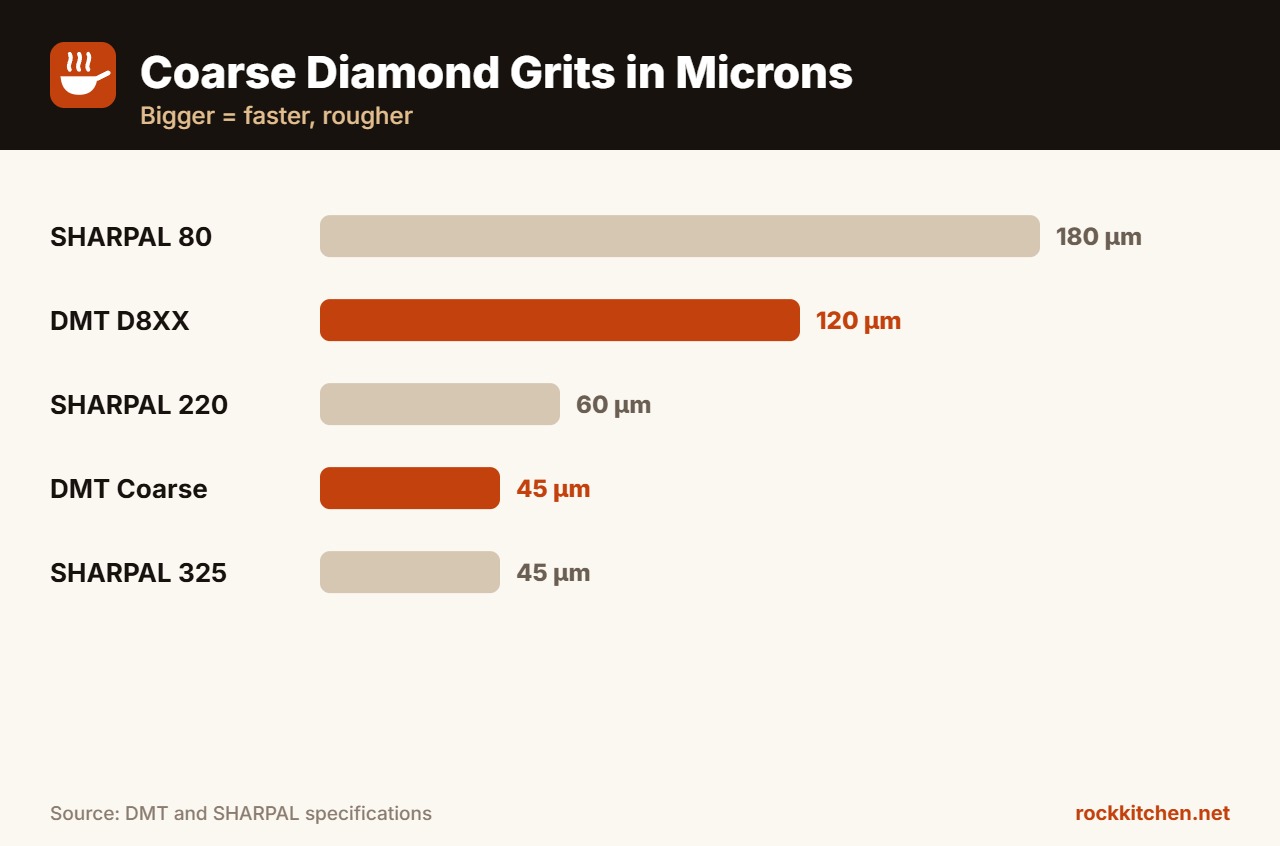
Microns Tell the Truth
DMT coarse is 45 µm, SHARPAL 220 is 60 µm and the D8XX is 120 µm. Bigger numbers cut faster and leave deeper scratches.
Always Follow with a Finer Grit
A coarse plate leaves a rough edge; follow with 600–1000 grit or a waterstone.
Plate Size
8 in. plates suit chef’s knives and flattening; 6 in. bars suit guided systems.
Light Pressure
Coarse diamond is aggressive; heavy pressure only removes extra steel.
Tips for Using a Coarse Diamond Plate
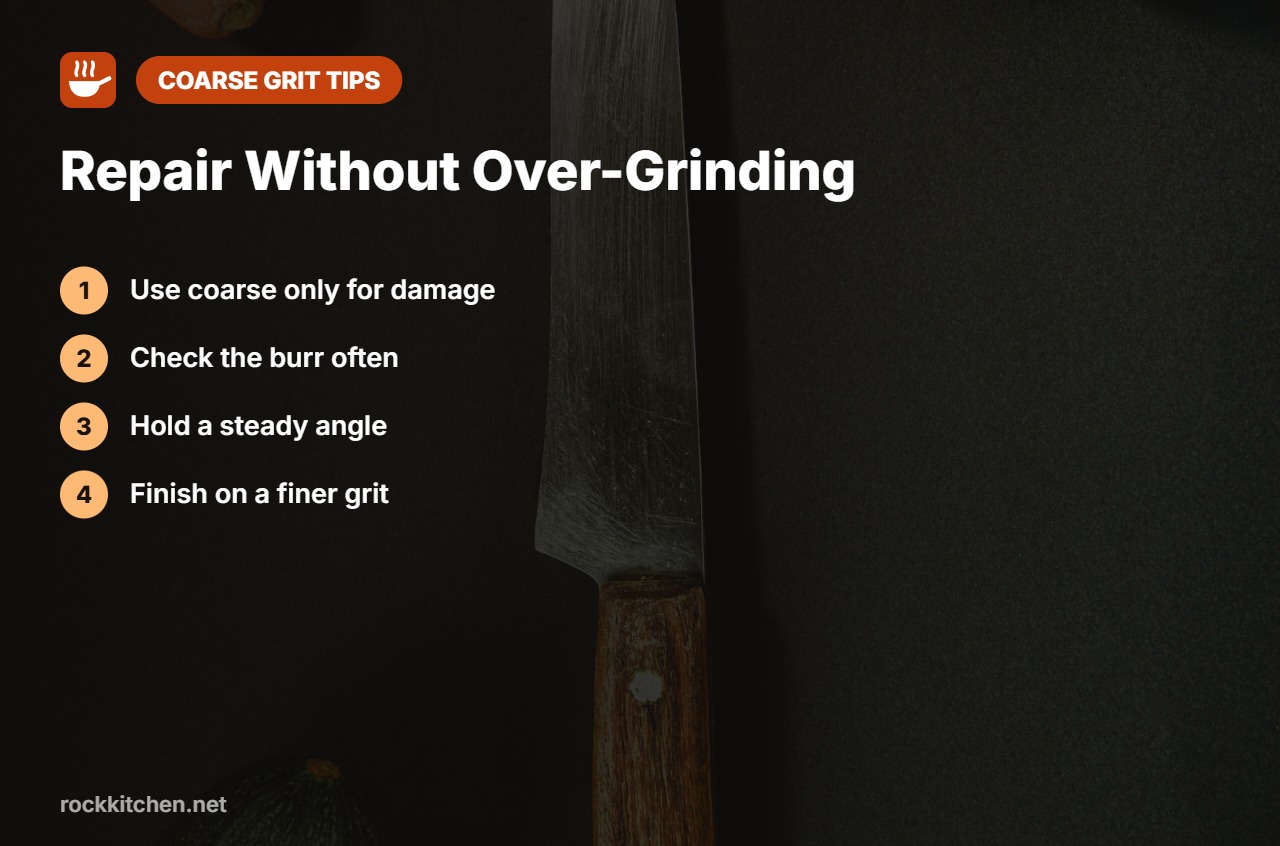
- Only use coarse grit when the edge is damaged.
- Check for a burr often so you do not over-grind.
- Keep the angle steady to avoid a rounded bevel.
- Move to a finer grit as soon as the chip is gone.
- Rinse and dry the plate after use.
Common questions about choosing the best coarse diamond plate.
Frequently Asked Questions
What is the best coarse diamond plate for chipped knives?
The DMT D8C or Atoma #140 is the best coarse diamond plate for chips, depending on how deep they are.
Can a coarse diamond plate flatten waterstones?
Yes. #140–#400 plates flatten waterstones quickly.
Is coarse diamond bad for knives?
No, but it removes steel fast, so use it only for repair.
What grit should follow a coarse plate?
Move to 600–1000 grit, then a finer stone if you want polish.
Final Verdict
Our final pick for the best coarse diamond plate is the DMT D8C. Choose the Atoma #140 for flattening or the SHARPAL 169H for two grits.
Related Guides
Keep building your sharpening setup with these guides:
- Best Atoma Plate 2026
- Best DMT Diamond Stone 2026
- Best Diamond Plate for Flattening 2026
- How We Test and Research Kitchen Gear
- All Knife Sharpening Guides
Prices and availability change often. Check the current listing on Amazon before you buy.