

As an Amazon Associate we earn from qualifying purchases. Learn more about our affiliate disclaimer.
The best Japanese finishing stone turns a sharp edge into a refined one, whether you want a keen #5000–#6000 working edge or a #10000+ mirror polish. Japanese makers such as Suehiro, Kitayama, Shapton, Naniwa and King have refined these stones for decades.
We compared seven Japanese finishing stones from #5000 to #16000 by grit, hardness, soaking needs and feel, so you can choose the finish that suits the way you cook.
Quick Answer: The Best Japanese Finishing Stone
- Best OverallSuehiro Rika #5000 Finishing Stone (No Base)
- Best PolishKitayama #8000 Fine Grain Finishing Stone
- Best Mirror FinishShapton Kuromaku #12000 (K0705)
- Best Slim #12000Naniwa Kagayaki #12000 Professional Whetstone
- Best #10000Yoshihiro Toishi #10000 Whetstone
- Best ValueKing Deluxe Finishing #6000 (High-Grade Cutlery)
- Best Ultra-FineShapton GlassStone #16000 (Nano class)
The Suehiro Rika #5000 is the best Japanese finishing stone for most home cooks. For a mirror polish, choose the Kitayama #8000 or Shapton Kuromaku #12000.
Best Japanese Finishing Stone Comparison Table
| Product | Best For | Type | Key Feature | Buy |
|---|---|---|---|---|
| Suehiro Rika 5000 | Best Overall | Finishing stone | #5000 ceramic, 900 g | Check Price |
| Kitayama 8000 | Best Polish | Finishing stone | #8000 fine grain | Check Price |
| Shapton Kuromaku 12000 | Best Mirror Finish | Ceramic finishing stone | #12000 for gloss and long-lasting edges | Check Price |
| Naniwa Kagayaki 12000 | Best Slim #12000 | Ceramic finishing stone | #12000 super fine with storage case | Check Price |
| Yoshihiro 10000 | Best #10000 | Finishing stone | #10000, made in Japan | Check Price |
| King Deluxe 6000 | Best Value | Finishing stone | #6000, 207 x 66 x 20 mm | Check Price |
| GlassStone 16000 | Best Ultra-Fine | Glass-backed stone | #16000, nano class | Check Price |
The 7 Best Japanese Finishing Stones
The best Japanese finishing stone depends on how polished you want your edge.

1. Suehiro Rika #5000 Finishing Stone (No Base)
1. The Rika #5000 ceramic stone gives a keen, versatile edge with great feedback. It is the best Japanese finishing stone for everyday knives.
👍 Pros & Cons
Pros
- Cult-favorite finishing stone
- Large and heavy
- Leaves a refined, polished edge
Cons
- Soaking type
📄 Detailed Review
- Grit: #5000
- Material: Ceramic
- Weight: 900 g
- Note: Current version has no surface markings
The Rika #5000 is one of the best-known Japanese finishing stones. This version has no base and weighs 900 g.
It gives a hazy-polished bevel and a very keen edge.

2. Kitayama #8000 Fine Grain Finishing Stone
2. The Kitayama #8000 is a classic polishing stone with a smooth feel.
👍 Pros & Cons
Pros
- Well-known #8000 polish
- Smooth, fine finish
Cons
- Few details in the listing
📄 Detailed Review
- Grit: #8000
- Brand: Kitayama
- Use: Final polishing
The Kitayama #8000 is a long-standing favorite for a fine, polished finish.
It works after a #1000–#3000 stone.

3. Shapton Kuromaku #12000 (K0705)
3. Shapton Kuromaku #12000 for a final, glossy polish.
👍 Pros & Cons
Pros
- Very high polish
- Listed for long cutting life and gloss
Cons
- Specialist grit
- Little benefit on soft German steels
📄 Detailed Review
- Grit: #12000
- Size: 210 x 70 x 15 mm
- Item: K0705
- Use: Final polish, gloss
The K0705 is Shapton’s #12000 finishing stone, described as having unusual polishing power that produces a long-lasting edge and gloss.
It is best for hard Japanese steels and single-bevel knives.

4. Naniwa Kagayaki #12000 Professional Whetstone
4. A 10 mm Naniwa #12000 with case for super-fine polishing.
👍 Pros & Cons
Pros
- Mirror-level polish
- Storage case protects the stone
- Listed for long-lasting cutting edges
Cons
- Thin 10 mm stone
- Benefit is small for everyday cooks
📄 Detailed Review
- Grit: #12000
- Size: 210 x 70 x 10 mm (8.3 x 2.8 x 0.4 in.)
- Includes: Storage case
- Use: Super fine sharpening and polishing
Kagayaki is Naniwa’s #12000 super-finishing stone, listed for super fine sharpening and a final polish that gives the edge shine.
It is a luxury step for sushi knives, single-bevel blades and anyone chasing a mirror finish.
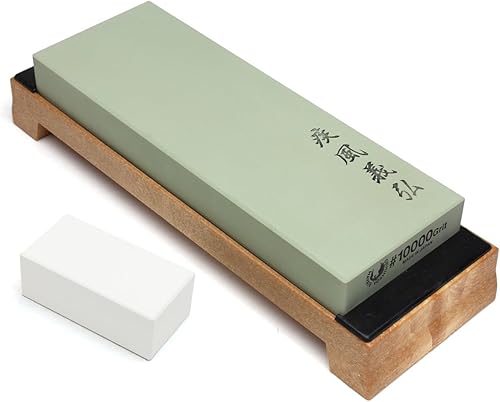
5. A thick Yoshihiro #10000 made in Japan.
👍 Pros & Cons
Pros
- Mirror-level finishing
- Made in Japan
Cons
- Specialist grit
📄 Detailed Review
- Grit: #10000
- Size: 8 x 2.9 x 0.9 in. (without base)
- Origin: Made in Japan
Yoshihiro’s #10000 is a high-grit finishing stone, 8 x 2.9 x 0.9 inches, made in Japan.
Use it as the last step on hard Japanese steels.

6. King Deluxe Finishing #6000 (High-Grade Cutlery)
6. A Japanese-made King #6000 that leaves a refined but grippy edge.
👍 Pros & Cons
Pros
- Full-size finishing stone
- Made for high-grade cutlery
Cons
- Newer listing
📄 Detailed Review
- Grit: #6000
- Size: 207 x 66 x 20 mm
- Weight: Approx. 600 g
- Origin: Japan
This King Deluxe #6000 is a full-size finishing stone sold for high-grade cutlery, about 600 g.
It gives a polished edge at a fair price.

7. Shapton GlassStone #16000 (Nano class)
7. Shapton GlassStone #16000 (nano class) for enthusiasts chasing a mirror.
👍 Pros & Cons
Pros
- Mirror finishing
- Uniform particle size
Cons
- Specialist and expensive
- Small gain for most cooks
📄 Detailed Review
- Grit: #16000 (nano class)
- Abrasive: Very dense, uniform particles
- Type: CA
The #16000 GlassStone is a nano-class stone with very dense, uniform abrasive particles.
It is for enthusiasts chasing a mirror edge on straight razors or single-bevel knives.
How We Chose the Best Japanese Finishing Stone
To choose the best Japanese finishing stone, we compared grit, binder hardness, soaking needs, thickness and owner feedback on polish, feel and wear. We also looked at price per millimetre of usable stone, the quality of included holders and how clearly each maker explains soaking, flattening and care, since those details shape how pleasant a stone is to use week after week.
Wash your knife and board after sharpening, following USDA Food Safety and Inspection Service cleanliness guidance. Our method is on the How We Test page.
Buying Guide: How to Choose the Best Japanese Finishing Stone
Pick Your Finish
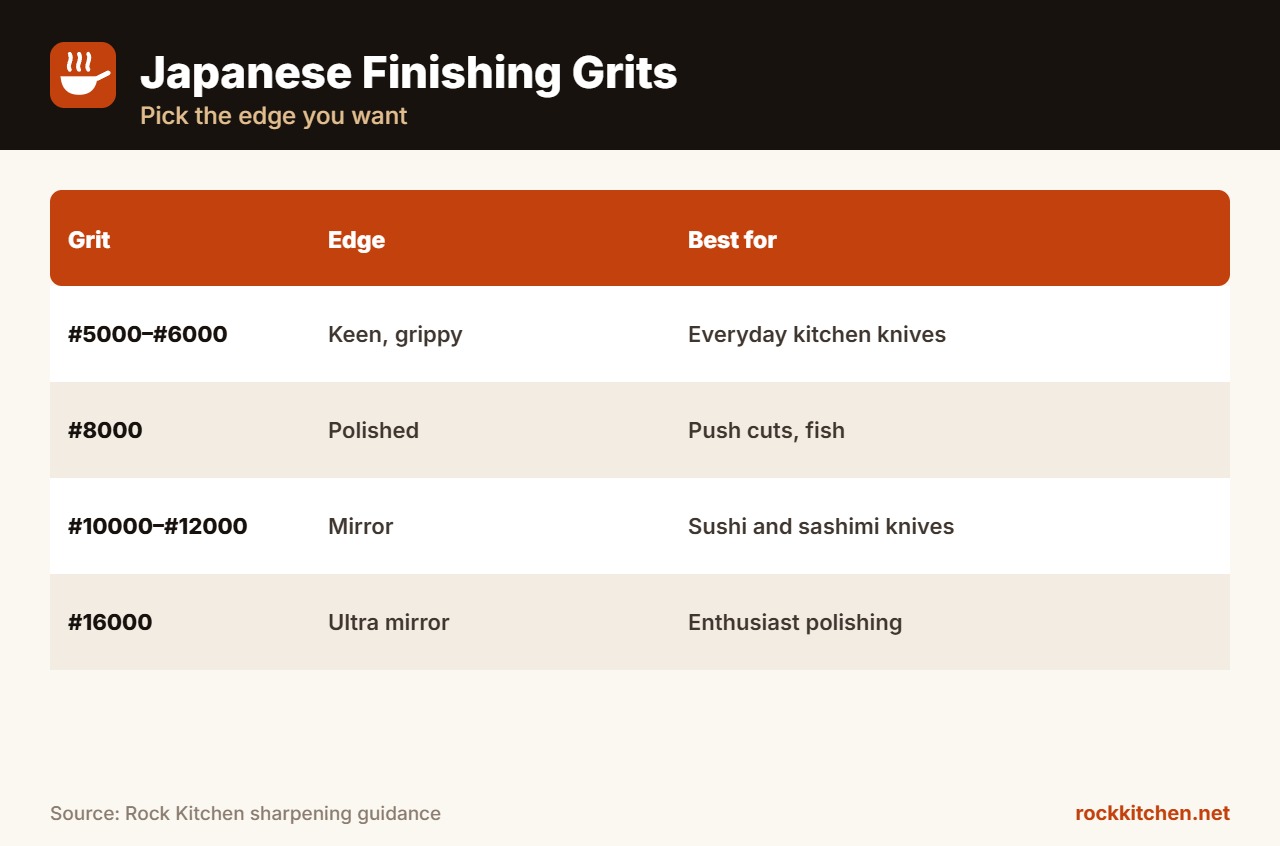
#5000–#6000 gives a keen, grippy edge; #8000–#10000 a polished edge; #12000+ a mirror finish mostly for enthusiasts. Most home cooks are happiest in the #5000–#8000 range, which balances bite, polish and edge life on stainless and carbon steel.
Soaking vs. Splash-and-Go
Suehiro Rika and Kitayama are soaking stones; Shapton Kuromaku and GlassStone only need surface water. Soaking stones take ten minutes or more to prepare, so splash-and-go stones suit cooks who sharpen in short sessions before dinner.
Feel and Feedback
Softer stones give more feedback; harder stones cut faster and stay flat longer. If you are new to sharpening, a slightly softer stone teaches you to hold a steady angle because it tells you when you rock the blade.
Do Not Skip Steps
A very fine stone after #1000 is slow. Use #3000–#5000 before #8000 or higher. A #3000 stone is a good bridge, and some cooks pair a #1000 with a #5000 and only add a polishing stone later.
Flatness Matters Most
A finishing stone that is not flat will round the edge. Flatten with a diamond plate before polishing sessions. Check flatness with a pencil grid before you start, and flatten gently, since fine stones are thinner and wear away quickly if over-flattened.
Tips for Using a Japanese Finishing Stone
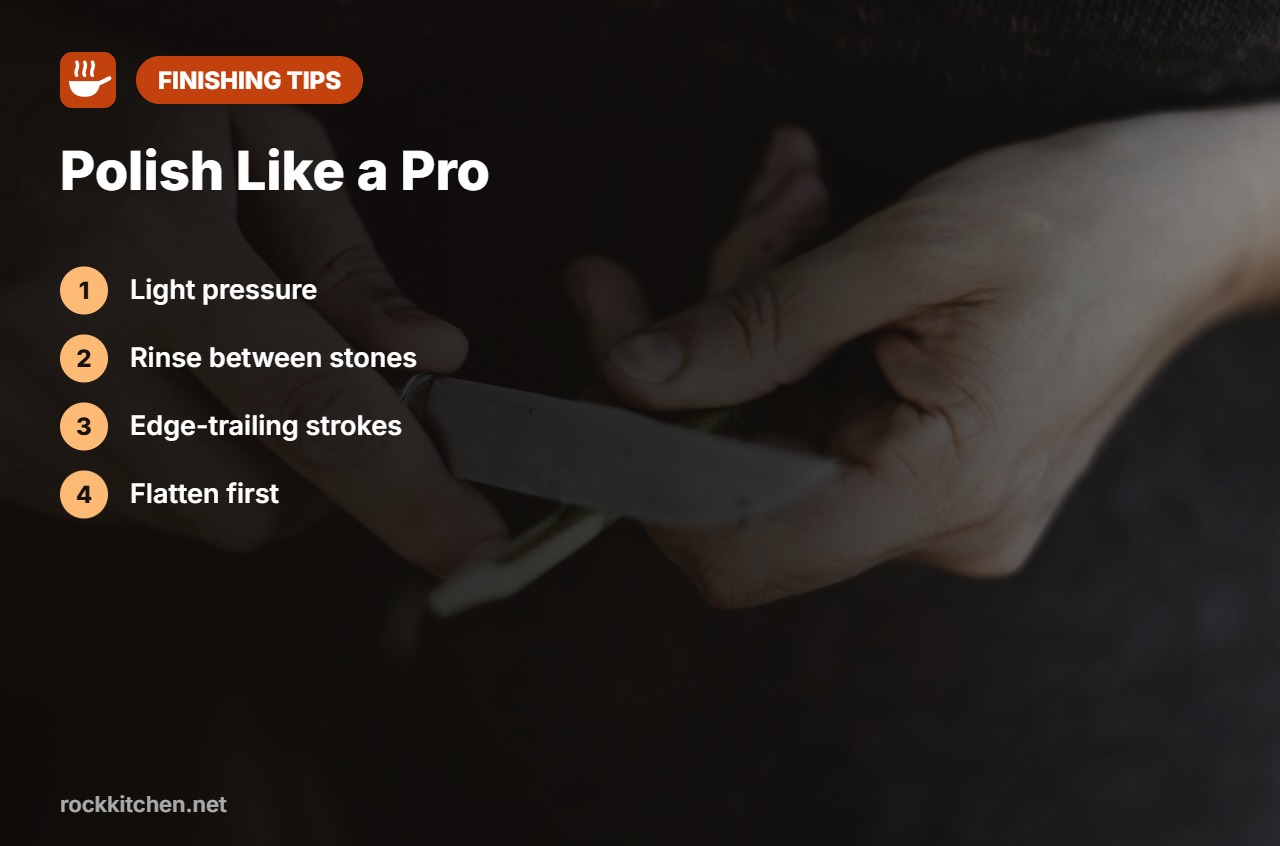
- Use very light pressure on finishing stones.
- Rinse the knife before switching stones.
- Finish with a few edge-trailing strokes.
- Flatten the stone before polishing sessions.
- Let soaking stones dry slowly.
Common questions about the best Japanese finishing stone.
Frequently Asked Questions
What is the best Japanese finishing stone for beginners?
The Suehiro Rika #5000 is the best Japanese finishing stone for beginners because it is forgiving and versatile.
Is a higher grit always better?
No. Very high grits polish, but #5000–#6000 often cuts food better.
Do I need a natural stone?
No. Modern synthetic Japanese stones are consistent and easier to use.
How often should I use a finishing stone?
After your #1000 stone, whenever you sharpen.
Final Verdict
Our final pick for the best Japanese finishing stone is the Suehiro Rika #5000. Choose the Kitayama #8000 for polish or the Shapton #12000 for a mirror.
Related Guides
Keep building your sharpening setup with these guides:
- Best 8000 Grit Whetstone 2026
- Best 5000 Grit Whetstone 2026
- Best Japanese Whetstone Brand 2026
- How We Test and Research Kitchen Gear
- All Knife Sharpening Guides
Prices and availability change often. Check the current listing on Amazon before you buy.