
As an Amazon Associate we earn from qualifying purchases. Learn more about our affiliate disclaimer.
Water stone vs oil stone is the oldest debate in knife sharpening. Water stones, mostly Japanese, use water as a lubricant, cut quickly and leave a refined edge, but they wear and need flattening. Oil stones, such as Norton India and natural Arkansas, use honing oil, cut more slowly and wear very little.
Here is which one suits a home kitchen.
Quick Answer: The Water Stone vs Oil Stone
- Best Water StoneShapton Kuromaku #1000 (K0702, Orange)
- Best Oil StoneNorton Combination Grit Oil Stone 8 x 2 x 1 in. (Fine/Coarse)
- Best Budget Water StoneKING KW65 1000/6000 Grit Combination Whetstone with Base
- Best Oil Stone KitSmith’s TRI6 Arkansas Tri-Hone Sharpening System (6 in.)
- Best Starter Water StoneSharp Pebble Whetstone Knife Sharpener, 1000/6000 Grit with Bamboo Base and Angle Guide
- Best Natural Oil StoneDan’s Soft Arkansas Genuine Natural Novaculite Whetstone
For most home cooks, a water stone like the KING KW65 or Shapton Kuromaku #1000 is faster and easier to clean up. Choose an oil stone like the Norton combination stone or Smith’s Tri-Hone if you also sharpen tools, want a stone that barely wears, and do not mind oil.
Water Stone vs Oil Stone Comparison Table
| Product | Best For | Type | Key Feature | Buy |
|---|---|---|---|---|
| Shapton Kuromaku 1000 | Best Water Stone | Ceramic whetstone | #1000 medium, 210 x 70 x 15 mm | Check Price |
| Norton Combination Oil Stone | Best Oil Stone | Synthetic oil stone | Coarse and fine sides, prefilled with oil | Check Price |
| KING KW65 | Best Budget Water Stone | Synthetic combination waterstone | 1000/6000 grit with plastic base | Check Price |
| Smith’s Tri-Hone | Best Oil Stone Kit | Oil stone system | Fine Arkansas plus medium and coarse synthetic stones | Check Price |
| Sharp Pebble 1000/6000 | Best Starter Water Stone | Combination whetstone kit | 1000/6000 corundum stone, bamboo base, angle guide | Check Price |
| Dan’s Soft Arkansas | Best Natural Oil Stone | Natural Arkansas oil stone | Soft (medium) grade novaculite bench stone | Check Price |
6 Picks: Water Stones and Oil Stones
Three water stones and three oil stones.

1. Shapton Kuromaku #1000 (K0702, Orange)
1. Kuromaku.
👍 Pros & Cons
Pros
- Cuts fast enough to double as a coarse stone
- Case doubles as a stone holder
- Hugely popular first stone
Cons
- Single grit only
- Thin compared with soaking stones
📄 Detailed Review
- Grit: #1000 (medium)
- Size: 210 x 70 x 15 mm
- Item: K0702
- Use: Rough or medium sharpening
Shapton describes the orange K0702 as a #1000 medium stone with enough bite to be used for rough or medium sharpening.
It is one of the most recommended first whetstones for kitchen knives because it cuts quickly and stays relatively flat.

2. Norton Combination Grit Oil Stone 8 x 2 x 1 in. (Fine/Coarse)
2. Norton.
👍 Pros & Cons
Pros
- Prefilled with oil so it stays lubricated
- Fast on dull knives
Cons
- Fine side is still fairly coarse; add a finisher
- Synthetic
📄 Detailed Review
- Grits: Coarse / fine (listed as 100 and 280)
- Size: 8 x 2 x 1 in.
- Feature: Prefilled with oil
- Brand: Norton
Norton’s oil stones are the classic American bench stones. This combination stone is prefilled with oil.
It repairs dull edges fast; pair it with a Hard Arkansas for a finer finish.

3. KING KW65 1000/6000 Grit Combination Whetstone with Base
3. KING KW65.
👍 Pros & Cons
Pros
- The classic Japanese starter stone
- Builds the skills you need before a natural stone
Cons
- Soaking stone
- Wears and dishes faster than hard stones
📄 Detailed Review
- Grits: 1000 / 6000
- Size: 8 x 2.5 x 1 in.
- Base: Plastic stand
- Made in: Japan
Most sharpeners learn on a 1000/6000 synthetic before buying a natural stone. The King KW65 is the most common choice.
Use the 1000 side to set the edge, then move to a natural finishing stone when your angle is consistent.

4. Smith’s TRI6 Arkansas Tri-Hone Sharpening System (6 in.)
4. Tri-Hone.
👍 Pros & Cons
Pros
- Three stones on a rotating base
- Includes oil and an angle guide
Cons
- 6 in. stones are short for chef knives
- Only the fine stone is natural Arkansas
📄 Detailed Review
- Stones: Fine Arkansas, medium and coarse synthetic
- Length: 6 in.
- Base: Rotating, non-skid
- Extras: Angle guide and honing oil
Smith’s Tri-Hone mounts three 6 in. stones on a rotating base, with a natural Arkansas stone as the fine finisher.
It is one of the most popular oil-stone kits on Amazon and a practical all-in-one for home cooks.

5. Sharp Pebble Whetstone Knife Sharpener, 1000/6000 Grit with Bamboo Base and Angle Guide
5. Sharp Pebble.
👍 Pros & Cons
Pros
- Two useful grits in one stone
- Base and angle guide help beginners
Cons
- Soaking stone; needs flattening over time
- Angle guide is a crutch for very thin Japanese edges
📄 Detailed Review
- Grits: #1000 / #6000
- Abrasive: Corundum (aluminum oxide)
- Size: 7.25 x 2.25 x 1 in.
- Includes: Bamboo base, angle guide, instructions
Sharp Pebble’s 1000/6000 kit is a widely sold whetstone kit on Amazon US, and it is many home cooks’ first stone.
The #1000 side sets a sharp edge and the #6000 side polishes it, which covers routine sharpening for most kitchen knives.

6. Dan’s Soft Arkansas Genuine Natural Novaculite Whetstone
6. Dan’s Soft.
👍 Pros & Cons
Pros
- Natural stone that lasts for years
- Good medium polish
- Made in Arkansas
Cons
- Slow on very dull knives
- Needs oil or water and cleanup
📄 Detailed Review
- Stone: Soft Arkansas novaculite (listing)
- Use: With honing oil or water (maker)
- Size: See listing
Dan’s medium-grade stone.
Best soft Arkansas.
How We Chose the Water Stone vs Oil Stone
For this water stone vs oil stone guide, we compared whetstones, diamond plates, oil stones and knife sharpeners listed on Amazon US by abrasive type, grit, size, hardness, angle control, speed and price, using product details from the listings and makers rather than a hands-on lab test. We then looked at common praise and complaints in buyer feedback for edge quality, wear, dishing, mess and learning curve. Prices and listings change often, so check the current listing before you buy.
Keep fingers behind the edge, sharpen on a stable non-slip base, keep metal swarf away from food, and wash knives before they touch food again, and follow USDA Food Safety and Inspection Service cleanliness guidance for kitchen hygiene. Our method is explained on the How We Test page.
Water Stone vs Oil Stone: Key Differences
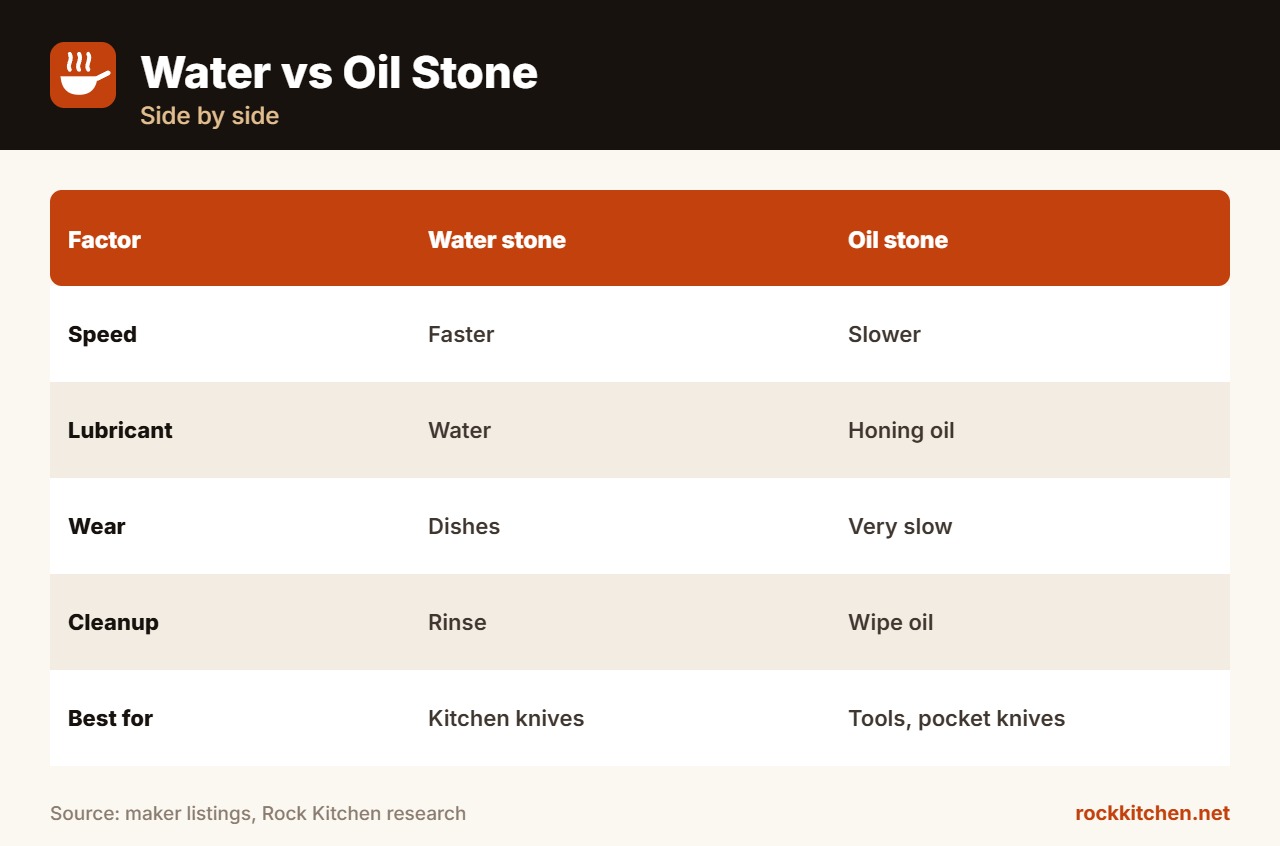
Speed
Water stones generally cut faster at the same grit.
Lubricant
Water stones use water; oil stones use light honing oil.
Mess
Water stones make muddy slurry; oil stones leave oily residue on hands and counters.
Wear
Water stones dish and need flattening; oil stones wear very slowly.
Finish
Fine water stones reach a higher polish; hard Arkansas oil stones also polish well, slowly.
Tips for Safer, Sharper Edges
- Hold a steady angle; consistency matters more than the exact number.
- Raise a small burr along the full edge before moving to a finer grit.
- Use light pressure on finishing grits.
- Flatten water stones often so they do not dish.
- Rinse and dry knives, then wipe stones clean after use.
Quick answers to common questions about water stone vs oil stone.
Frequently Asked Questions
Can I use water on an oil stone?
Some can be used with water if never oiled; once oiled, keep using oil.
Can I use cooking oil?
It is better to use honing oil; cooking oil can go sticky and rancid.
Which is better for Japanese knives?
Water stones are the usual choice.
Do oil stones need flattening?
Rarely, but they can glaze and need cleaning.
Final Verdict
Our water stone vs oil stone verdict: the Shapton Kuromaku #1000 is the best kitchen choice, while the Norton combination stone suits tool and pocket knife sharpening.
Related Guides
Keep exploring knives and sharpening with these guides:
Prices and availability change often. Check the current listing on Amazon before you buy.