
As an Amazon Associate we earn from qualifying purchases. Learn more about our affiliate disclaimer.
Diamond vs ceramic sharpening stone compares two modern abrasives. Diamond plates carry diamond particles bonded to steel, while ceramic stones use aluminum oxide or similar abrasive in a hard bonded block, such as Shapton’s splash-and-go stones. Diamond is the speed tool; ceramic is the everyday sharpening and finishing tool.
Here is how to pick between them.
Quick Answer: The Diamond vs Ceramic Sharpening Stone
- Best Diamond for RepairDMT D8C Dia-Sharp 8-Inch Coarse Bench Stone
- Best Ceramic StoneShapton Kuromaku #1000 (K0702, Orange)
- Best Value DiamondSHARPAL 162N Double-Sided Diamond Stone, 8 x 3 in.
- Best Ceramic FinisherShapton GlassStone #4000 (3 micron)
- Best Fine DiamondDMT D8E Dia-Sharp 8-Inch Extra Fine Bench Stone
- Best Budget CeramicSuehiro Cerax 1010 #1000 Stone
Pick a diamond plate like the DMT D8C or SHARPAL 162N for dull knives, chips and very hard steels. Pick a ceramic stone like the Shapton Kuromaku #1000 or Shapton GlassStone #4000 for regular sharpening and a smoother, more polished edge. A diamond coarse plate plus a ceramic medium stone is a strong two-stone kit.
Diamond vs Ceramic Sharpening Stone Comparison Table
| Product | Best For | Type | Key Feature | Buy |
|---|---|---|---|---|
| DMT D8C (Coarse) | Best Diamond for Repair | Diamond bench stone | Continuous coarse diamond, made in USA | Check Price |
| Shapton Kuromaku 1000 | Best Ceramic Stone | Ceramic whetstone | #1000 medium, 210 x 70 x 15 mm | Check Price |
| SHARPAL 162N | Best Value Diamond | Two-sided diamond plate | 325 / 1200 grit with angle guide | Check Price |
| GlassStone 4000 | Best Ceramic Finisher | Glass-backed stone | #4000, 3 µm class | Check Price |
| DMT D8E (Extra Fine) | Best Fine Diamond | Diamond bench stone | Extra fine continuous diamond for refining | Check Price |
| Suehiro Cerax 1000 | Best Budget Ceramic | Soaking stone | #1000 medium, immersion type | Check Price |
6 Picks: Diamond and Ceramic Stones
Three diamond plates and three ceramic stones.

1. DMT D8C Dia-Sharp 8-Inch Coarse Bench Stone
1. DMT Coarse.
👍 Pros & Cons
Pros
- Continuous surface works for pointed tips and small tools
- Sharpen dry or with water, no messy oil
- Designed not to hollow or groove
Cons
- Coarse grit needs a finer stone afterwards
- Diamond surfaces feel aggressive for the first few uses
📄 Detailed Review
- Surface: Continuous coarse monocrystalline diamond
- Length: 8 in.
- Base: 4 non-skid rubber feet
- Use: Dry or with water, no oil
- Origin: Made in USA
The D8C is DMT’s 8-inch coarse Dia-Sharp: a continuous (no polka-dot) diamond surface on a plate with rubber feet. It is built to repair dull and damaged edges quickly and to work dry or with water.
In a kitchen it is the “reset” stone: use it when an edge is badly rolled or chipped, then move to a fine stone. Because it stays flat, it can also level waterstones.

2. Shapton Kuromaku #1000 (K0702, Orange)
2. Kuromaku 1000.
👍 Pros & Cons
Pros
- Cuts fast enough to double as a coarse stone
- Case doubles as a stone holder
- Hugely popular first stone
Cons
- Single grit only
- Thin compared with soaking stones
📄 Detailed Review
- Grit: #1000 (medium)
- Size: 210 x 70 x 15 mm
- Item: K0702
- Use: Rough or medium sharpening
Shapton describes the orange K0702 as a #1000 medium stone with enough bite to be used for rough or medium sharpening.
It is one of the most recommended first whetstones for kitchen knives because it cuts quickly and stays relatively flat.

3. SHARPAL 162N Double-Sided Diamond Stone, 8 x 3 in.
3. SHARPAL.
👍 Pros & Cons
Pros
- Two useful grits on a full-size 8 x 3 in. plate
- Box doubles as a non-slip base
- Angle guide helps beginners
Cons
- 1200 is the finest grit; no polishing side
- Electroplated diamond feels aggressive when new
📄 Detailed Review
- Grits: Coarse 325 (45 µm) / Extra fine 1200 (12 µm)
- Size: 8 x 3 in.
- Base: 0.35 in. stainless steel, electroplated diamond
- Extras: Storage box, non-slip pad, 4-angle guide (14°–25°)
The SHARPAL 162N puts coarse 325 grit (45 micron) and extra fine 1200 grit (12 micron) on a stainless steel base 0.35 inch thick. SHARPAL says its MirrorFlat process keeps the surface flat for even contact.
The kit includes a storage box with a rubber pad that works as a base, plus an angle guide with 14, 17, 20 and 25 degree settings, which makes it an easy first diamond plate.

4. Shapton GlassStone #4000 (3 micron)
4. GlassStone 4000.
👍 Pros & Cons
Pros
- Excellent first finishing grit
- Glass base stays flat
Cons
- Premium price
📄 Detailed Review
- Grit: #4000 (3 micron class)
- Material: Glass backing with ceramic abrasive
- Finish: Ultra fine
The #4000 GlassStone is a 3 micron class stone described as ultra fine, on Shapton’s glass backing.
For kitchen knives it is a finishing stone that keeps some bite.

5. DMT D8E Dia-Sharp 8-Inch Extra Fine Bench Stone
5. DMT Extra Fine.
👍 Pros & Cons
Pros
- Refines an edge to a keen, toothy finish
- Excellent for hard and powder steels
- Low maintenance compared with soft finishing stones
Cons
- Too fine to fix damaged edges
- Leaves a less polished look than a high-grit waterstone
📄 Detailed Review
- Surface: Continuous extra fine diamond
- Length: 8 in.
- Base: Non-skid rubber feet
- Use: Dry or with water
- Origin: Made in USA
The extra fine D8E is DMT’s refining surface. It brings an edge from fine-diamond sharpness to a cleaner, keener finish while keeping the low-maintenance diamond format.
Cooks who prefer a slightly toothy edge for slicing tomatoes and crusty bread often stop here instead of polishing further.

6. Suehiro Cerax 1010 #1000 Stone
6. Cerax 1000.
👍 Pros & Cons
Pros
- Well-loved #1000 with a smooth feel
- Durable
Cons
- Must be soaked
📄 Detailed Review
- Grit: #1000 medium
- Type: Immersion (soaking)
- Model: Cerax 1010
The Cerax 1010 is Suehiro’s #1000 medium soaking stone, known for durability.
It builds slurry easily, which many sharpeners enjoy.
How We Chose the Diamond vs Ceramic Sharpening Stone
For this diamond vs ceramic sharpening stone guide, we compared whetstones, diamond plates, oil stones and knife sharpeners listed on Amazon US by abrasive type, grit, size, hardness, angle control, speed and price, using product details from the listings and makers rather than a hands-on lab test. We then looked at common praise and complaints in buyer feedback for edge quality, wear, dishing, mess and learning curve. Prices and listings change often, so check the current listing before you buy.
Keep fingers behind the edge, sharpen on a stable non-slip base, keep metal swarf away from food, and wash knives before they touch food again, and follow USDA Food Safety and Inspection Service cleanliness guidance for kitchen hygiene. Our method is explained on the How We Test page.
Diamond vs Ceramic Sharpening Stone: Key Differences
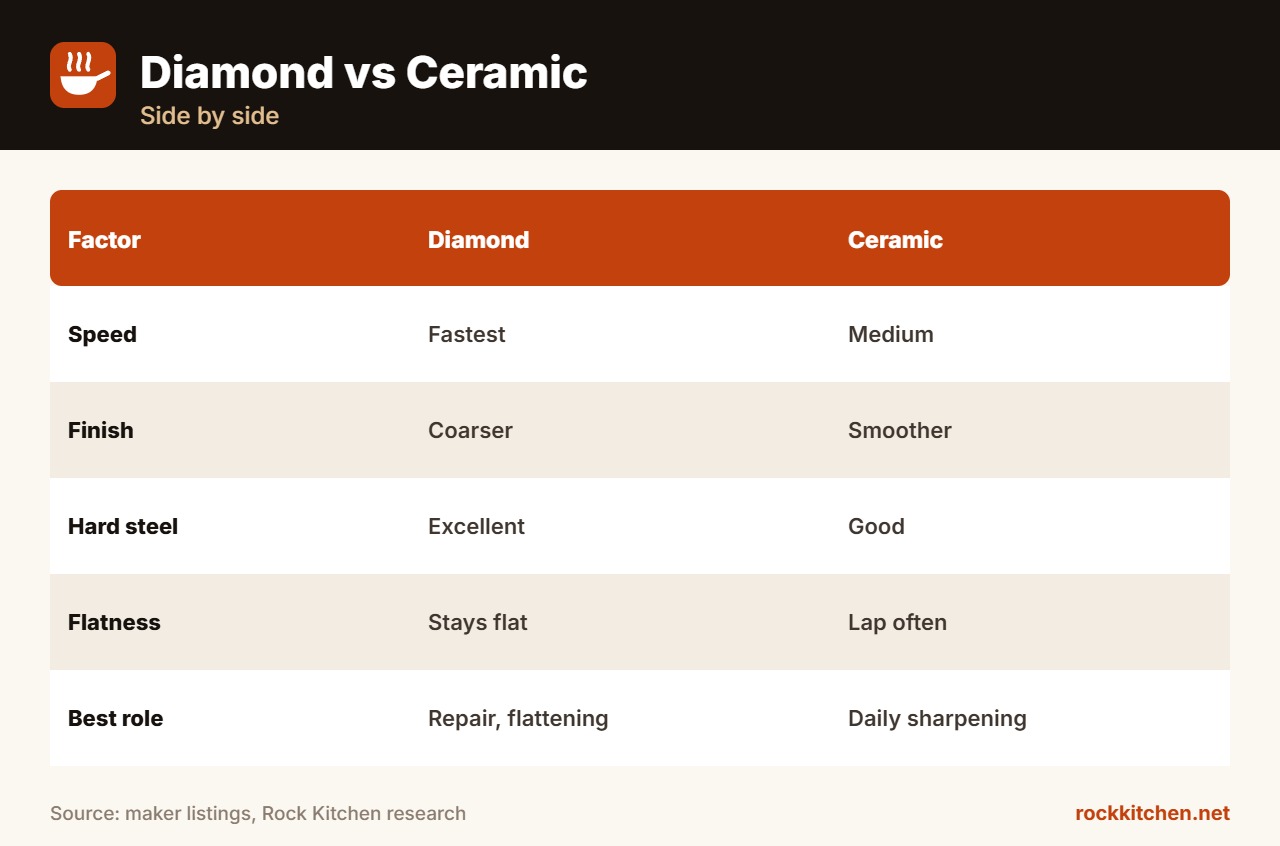
Speed
Diamond removes metal fastest; ceramic is slower but more controlled.
Edge finish
Ceramic stones leave a cleaner, more even scratch pattern.
Steel types
Diamond handles powder and very hard steels with ease; ceramic works well on most kitchen steels.
Flatness
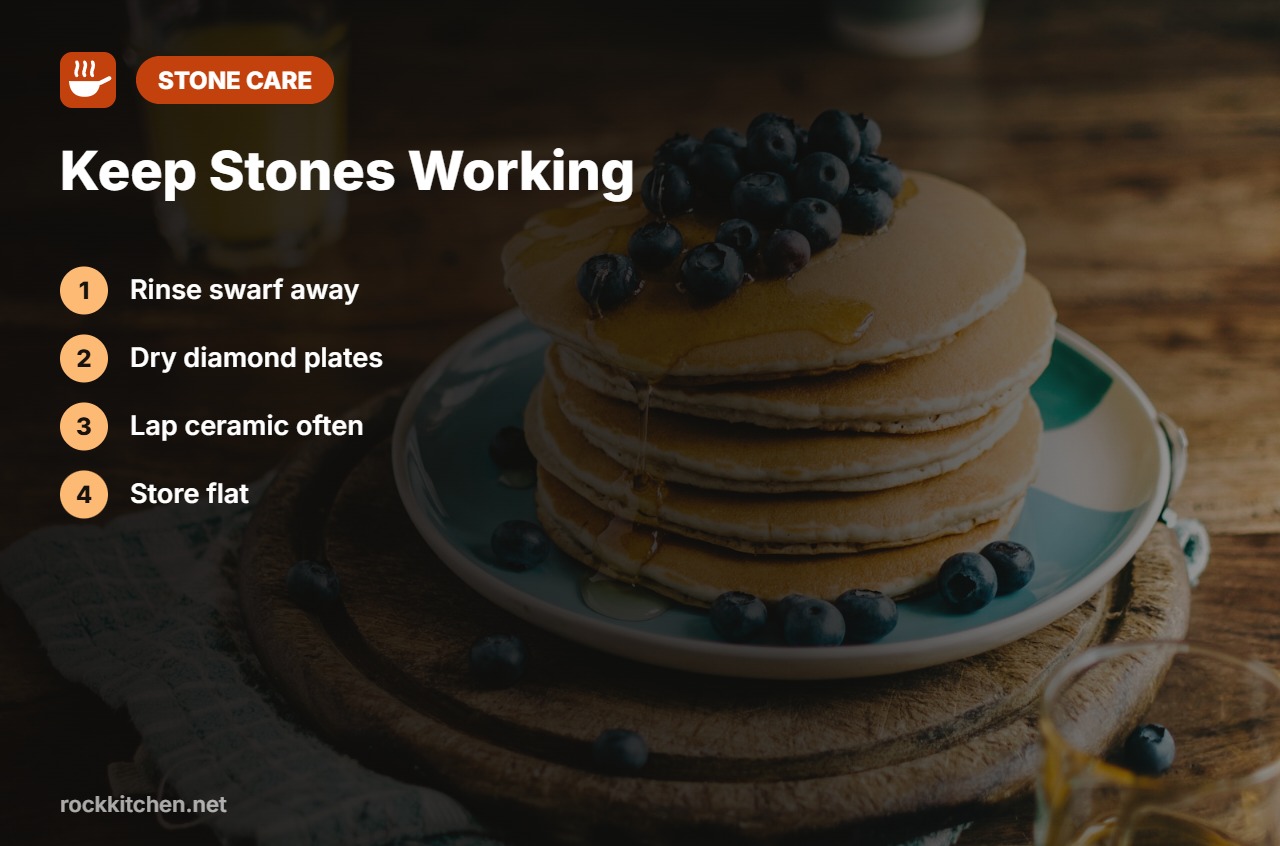
Diamond stays flat; ceramic stones wear slowly and need lapping.
Water
Both are usually used with water; check whether your ceramic stone needs soaking.
Tips for Safer, Sharper Edges
- Hold a steady angle; consistency matters more than the exact number.
- Raise a small burr along the full edge before moving to a finer grit.
- Use light pressure on finishing grits.
- Flatten water stones often so they do not dish.
- Rinse and dry knives, then wipe stones clean after use.
Quick answers to common questions about diamond vs ceramic sharpening stone.
Frequently Asked Questions
Is ceramic the same as a whetstone?
Many modern whetstones are ceramic-bonded abrasive; the terms overlap.
Which lasts longer?
Thick ceramic stones can last years; diamond coatings wear smooth over time.
Can I use oil on ceramic stones?
Most Japanese ceramic stones use water only; follow the maker.
What grit should I start with?
Around 1000 for regular sharpening; coarser only for damaged edges.
Final Verdict
Our diamond vs ceramic sharpening stone verdict: a DMT D8C handles repairs fast, and a Shapton Kuromaku #1000 is the best daily ceramic stone.
Related Guides
Keep exploring knives and sharpening with these guides:
Prices and availability change often. Check the current listing on Amazon before you buy.