
As an Amazon Associate we earn from qualifying purchases. Learn more about our affiliate disclaimer.
Shapton Pro vs Shapton Glass compares Shapton’s two main lines. Shapton Pro, sold as Kuromaku, is a thicker ceramic block that comes in a case that doubles as a holder. Shapton Glass, or GlassStone, is a thinner ceramic layer bonded to a glass backing, so it stays very flat and cuts quickly but has less material to wear through.
Here is which line suits you.
Quick Answer: The Shapton Pro vs Shapton Glass
- Best Shapton ProShapton Kuromaku #1000 (K0702, Orange)
- Best Shapton GlassShapton GlassStone #1000 (11 micron)
- Best Pro SetShapton Kuromaku A-Set (#1000 + #5000)
- Best Glass SetShapton Glass Stone Set with Field Holder
- Best Pro FinisherShapton Kuromaku #5000 (K0704)
- Best Glass FinisherShapton GlassStone #6000 (2 micron)
Choose Shapton Pro (Kuromaku), such as the #1000 or the A-Set, for better value per stone and a thicker block that lasts longer. Choose Shapton Glass, such as the GlassStone #1000 or #4000, if you want the flattest, fastest stones and are happy to buy a holder.
Shapton Pro vs Shapton Glass Comparison Table
| Product | Best For | Type | Key Feature | Buy |
|---|---|---|---|---|
| Shapton Kuromaku 1000 | Best Shapton Pro | Ceramic whetstone | #1000 medium, 210 x 70 x 15 mm | Check Price |
| GlassStone 1000 | Best Shapton Glass | Glass-backed stone | #1000, 11 µm, 8.25 x 2.75 in. | Check Price |
| Shapton A-set | Best Pro Set | Whetstone set | #1000 + #5000 with holder cases | Check Price |
| Shapton Glass Stone Set | Best Glass Set | Splash-and-go stone set | Three thin glass-backed stones with a holder | Check Price |
| Shapton Kuromaku 5000 | Best Pro Finisher | Ceramic finishing stone | #5000 finishing with storage case | Check Price |
| GlassStone 6000 | Best Glass Finisher | Glass-backed stone | #6000, 2 µm class | Check Price |
6 Picks: Shapton Pro and Glass Stones
Three Kuromaku stones and three GlassStones.

1. Shapton Kuromaku #1000 (K0702, Orange)
1. Kuromaku 1000.
👍 Pros & Cons
Pros
- Cuts fast enough to double as a coarse stone
- Case doubles as a stone holder
- Hugely popular first stone
Cons
- Single grit only
- Thin compared with soaking stones
📄 Detailed Review
- Grit: #1000 (medium)
- Size: 210 x 70 x 15 mm
- Item: K0702
- Use: Rough or medium sharpening
Shapton describes the orange K0702 as a #1000 medium stone with enough bite to be used for rough or medium sharpening.
It is one of the most recommended first whetstones for kitchen knives because it cuts quickly and stays relatively flat.

2. Shapton GlassStone #1000 (11 micron)
2. GlassStone 1000.
👍 Pros & Cons
Pros
- Splash-and-go convenience
- Long-lasting abrasive
- Glass backing keeps it usable when thin
Cons
- Hard feel takes getting used to
- Higher cost than Kuromaku #1000
📄 Detailed Review
- Grit: #1000 (11 micron class)
- Size: 8.25 x 2.75 in.
- Soaking: No need to soak
- Wear: Lasts longer than typical waterstones
Shapton’s GlassStone #1000 is in the 11 micron class, measures 8.25 x 2.75 inches and needs no soaking.
It is the most popular GlassStone grit and a good first stone in the series.
3. Shapton Kuromaku A-Set (#1000 + #5000)
3. A-Set.
👍 Pros & Cons
Pros
- Complete two-stone kit
- Cases double as holders
- No soaking wait
Cons
- No coarse stone for repairs
- Stock can be limited
📄 Detailed Review
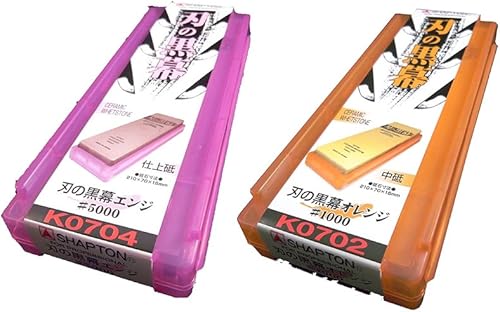
- Stones: #1000 medium + #5000 fine
- Working surface: 210 x 70 x 15 mm each
- Holders: Ventilated cases double as holders
The A-set bundles the #1000 and #5000 Kuromaku stones with ventilated plastic boxes that serve as holders. Shapton notes the #1000 also covers coarse duties.
For many cooks this pair is the whole kit.

4. Shapton Glass Stone Set with Field Holder
4. With holder.
👍 Pros & Cons
Pros
- No soaking needed
- Thin, hard stones stay flat longer
- Fast cutting
Cons
- Thin stones wear out sooner than thick ones
- Costly set
📄 Detailed Review
- Type: Splash-and-go ceramic (maker)
- Stones: Three grits (listing)
- Includes: Field holder
A Shapton Glass starter set.
Best Glass set.

5. Shapton Kuromaku #5000 (K0704)
5. Kuromaku 5000.
👍 Pros & Cons
Pros
- Strong polishing power for a finishing stone
- Case doubles as a holder
- Feels less “slick” than many finishers
Cons
- Thin stone; flatten gently
- Needs a #1000–#2000 before it
📄 Detailed Review
- Grit: #5000 (finishing)
- Size: 210 x 70 x 15 mm
- Item: K0704
- Extras: Storage case doubles as holder
Shapton says the K0704 avoids the overly smooth feel of traditional finishing stones while polishing well. The storage case can be used as a holder.
It is a natural partner for the orange #1000.

6. Shapton GlassStone #6000 (2 micron)
6. GlassStone 6000.
👍 Pros & Cons
Pros
- Polished edge on Japanese knives
- No soaking
Cons
- Little stock information
📄 Detailed Review
- Grit: #6000 (2 micron class)
- Size: 2.75 x 8.25 in.
The #6000 GlassStone sits in the 2 micron class and measures 2.75 x 8.25 inches.
It is a classic final stone for gyuto and santoku edges.
How We Chose the Shapton Pro vs Shapton Glass
For this shapton pro vs shapton glass guide, we compared whetstones, diamond plates, oil stones and knife sharpeners listed on Amazon US by abrasive type, grit, size, hardness, angle control, speed and price, using product details from the listings and makers rather than a hands-on lab test. We then looked at common praise and complaints in buyer feedback for edge quality, wear, dishing, mess and learning curve. Prices and listings change often, so check the current listing before you buy.
Keep fingers behind the edge, sharpen on a stable non-slip base, keep metal swarf away from food, and wash knives before they touch food again, and follow USDA Food Safety and Inspection Service cleanliness guidance for kitchen hygiene. Our method is explained on the How We Test page.
Shapton Pro vs Shapton Glass: Key Differences
Construction
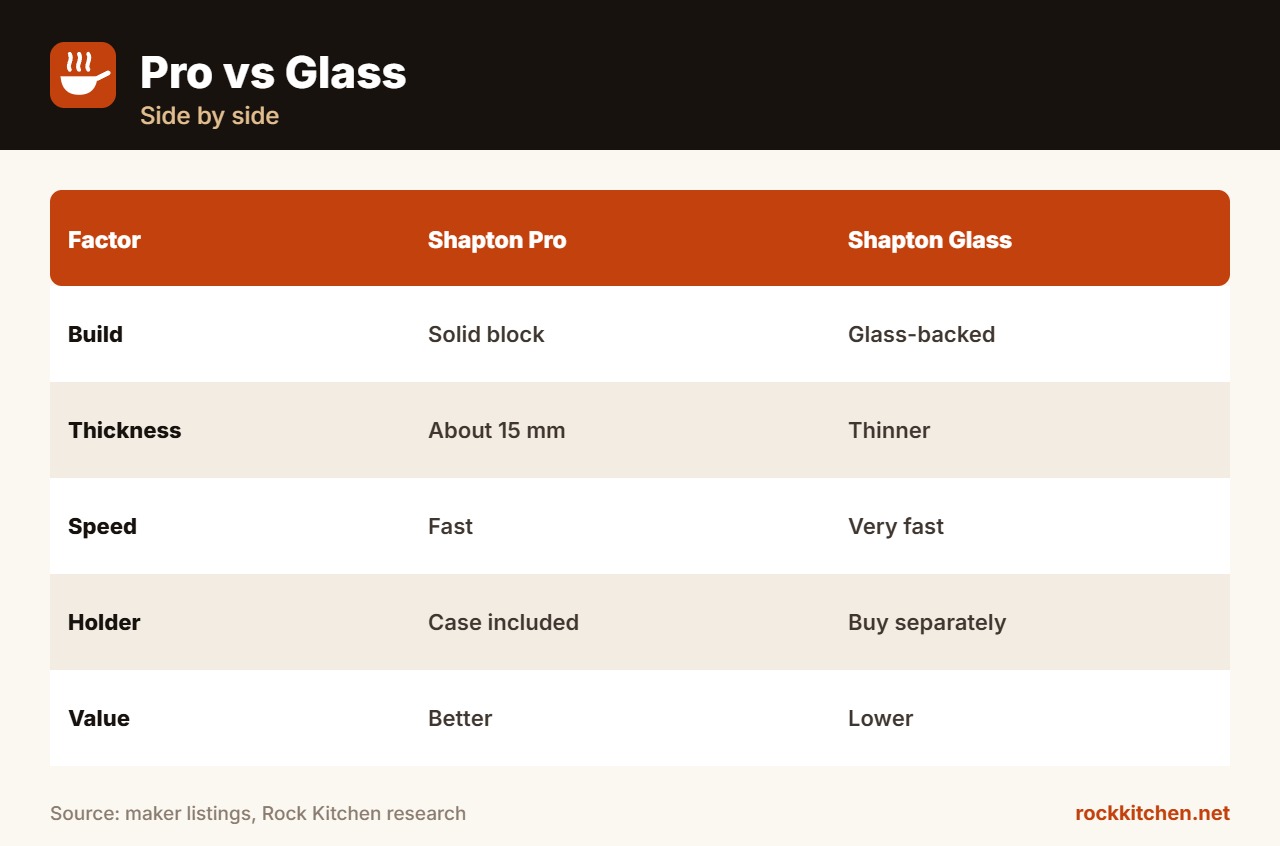
Pro is a solid ceramic block; Glass is ceramic bonded to a glass plate.
Thickness and lifespan
Pro blocks are about 15 mm; Glass stones are thinner, so they wear through sooner.
Feel
Glass feels firmer and faster; Pro is slightly more forgiving.
Holder
Pro cases double as holders; Glass needs a separate holder or base.
Value
Pro usually costs less per stone and per year of use.
Tips for Safer, Sharper Edges
- Hold a steady angle; consistency matters more than the exact number.
- Raise a small burr along the full edge before moving to a finer grit.
- Use light pressure on finishing grits.
- Flatten water stones often so they do not dish.
- Rinse and dry knives, then wipe stones clean after use.
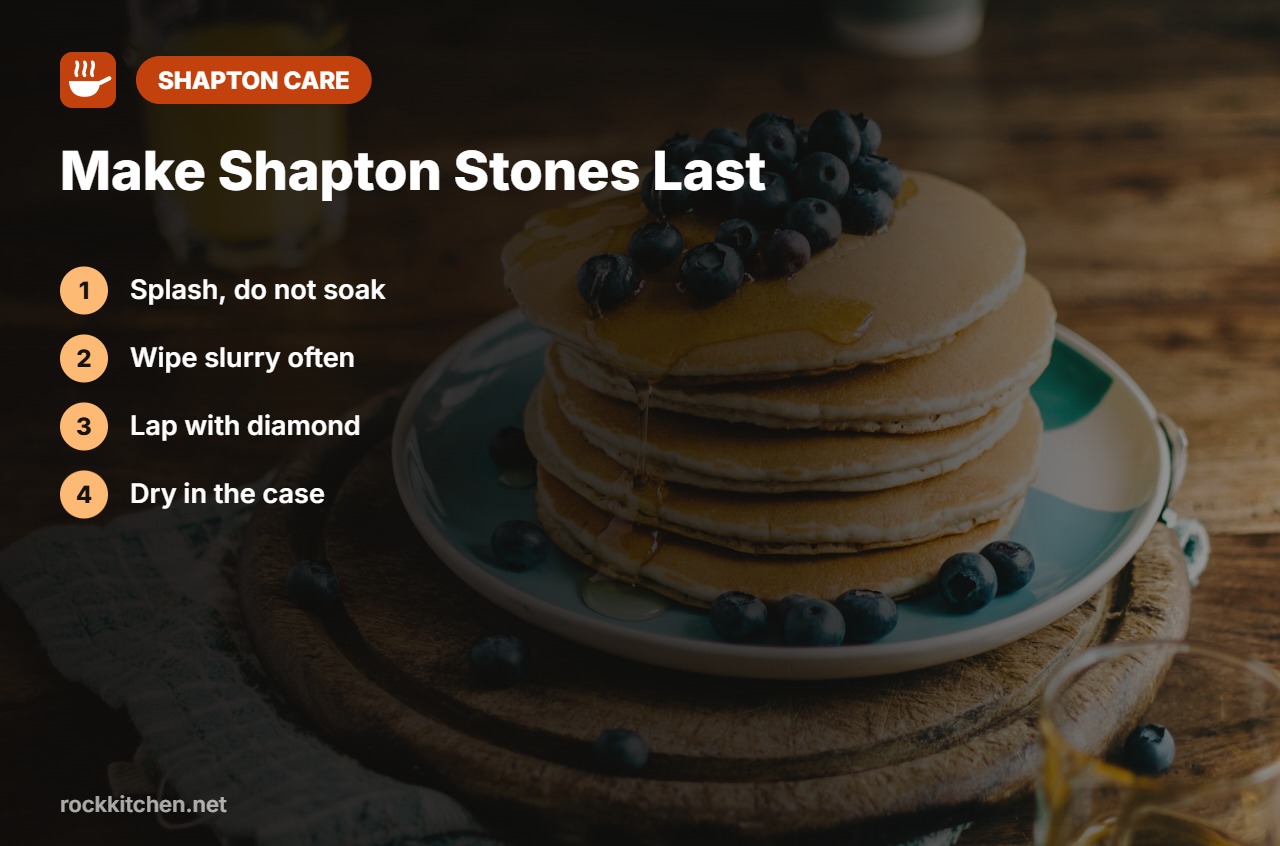
Quick answers to common questions about shapton pro vs shapton glass.
Frequently Asked Questions
Is Shapton Pro the same as Kuromaku?
Yes. Kuromaku is the Japanese name for the Shapton Pro line.
Do GlassStones need soaking?
No. A splash of water is enough.
Can the glass backing crack?
Avoid dropping it or heating it; handle it like any glass.
Which grits to start with?
#1000 for sharpening and #5000 or #6000 for finishing.
Final Verdict
Our Shapton Pro vs Shapton Glass verdict: the Kuromaku #1000 is the better value, while the GlassStone #1000 is the fastest and flattest.
Related Guides
Keep exploring knives and sharpening with these guides:
Prices and availability change often. Check the current listing on Amazon before you buy.