

As an Amazon Associate we earn from qualifying purchases. Learn more about our affiliate disclaimer.
The best finishing stone takes the edge from your #1000 stone and polishes it smooth, so it cuts with less force and stays sharp longer. Finishing stones range from #3000 to #12000 and beyond; most home cooks are happiest between #5000 and #8000.
We compared seven synthetic finishing stones on Amazon, from affordable classics to premium polishers.
Quick Answer: The Best Finishing Stone
- Best OverallSuehiro Rika #5000 Finishing Stone (No Base)
- Best #8000Kitayama #8000 Fine Grain Finishing Stone
- Best ValueKING #6000 Finishing Whetstone
- Best Splash-and-GoShapton Kuromaku #5000 (K0704)
- Best for Hard SteelShapton GlassStone #8000 (1 micron)
- Best NaniwaNaniwa Pure White #8000 Super Finishing Stone
- Best Ultra-FineNaniwa Kagayaki #12000 Professional Whetstone
The Suehiro Rika #5000 is our top pick for most cooks because it polishes well yet still leaves some bite. The Kitayama #8000 gives a finer mirror finish, and the King #6000 is the best value.
Best Finishing Stone Comparison Table
| Product | Best For | Type | Key Feature | Buy |
|---|---|---|---|---|
| Suehiro Rika 5000 | Best Overall | Finishing stone | #5000 ceramic, 900 g | Check Price |
| Kitayama 8000 | Best #8000 | Finishing stone | #8000 fine grain | Check Price |
| King 6000 | Best Value | Finishing stone | #6000, made in Japan | Check Price |
| Shapton Kuromaku 5000 | Best Splash-and-Go | Ceramic finishing stone | #5000 finishing with storage case | Check Price |
| GlassStone 8000 | Best for Hard Steel | Glass-backed stone | #8000, 1 µm class | Check Price |
| Naniwa Pure White 8000 | Best Naniwa | Finishing stone | #8000 finishing after medium sharpening | Check Price |
| Naniwa Kagayaki 12000 | Best Ultra-Fine | Ceramic finishing stone | #12000 super fine with storage case | Check Price |
The 7 Best Finishing Stones
Ranked by finish quality, feel and value.

1. Suehiro Rika #5000 Finishing Stone (No Base)
1. Smooth #5000 with a bit of bite.
👍 Pros & Cons
Pros
- Cult-favorite finishing stone
- Large and heavy
- Leaves a refined, polished edge
Cons
- Soaking type
📄 Detailed Review
- Grit: #5000
- Material: Ceramic
- Weight: 900 g
- Note: Current version has no surface markings
The Rika #5000 is one of the best-known Japanese finishing stones. This version has no base and weighs 900 g.
It gives a hazy-polished bevel and a very keen edge.

2. Kitayama #8000 Fine Grain Finishing Stone
2. Fine mirror finish.
👍 Pros & Cons
Pros
- Well-known #8000 polish
- Smooth, fine finish
Cons
- Few details in the listing
📄 Detailed Review
- Grit: #8000
- Brand: Kitayama
- Use: Final polishing
The Kitayama #8000 is a long-standing favorite for a fine, polished finish.
It works after a #1000–#3000 stone.

3. Classic #6000 at a fair price.
👍 Pros & Cons
Pros
- Affordable dedicated finishing stone
- Made in Japan
Cons
- Soft; can gouge if you press too hard
📄 Detailed Review
- Grit: #6000
- Origin: Made in Japan
- Note: No plastic compounds
King’s single #6000 finishing stone is made in Japan without plastic compounds.
It is an inexpensive way to add a polishing step to any #1000 stone.

4. Shapton Kuromaku #5000 (K0704)
4. No soaking, stays flat.
👍 Pros & Cons
Pros
- Strong polishing power for a finishing stone
- Case doubles as a holder
- Feels less “slick” than many finishers
Cons
- Thin stone; flatten gently
- Needs a #1000–#2000 before it
📄 Detailed Review
- Grit: #5000 (finishing)
- Size: 210 x 70 x 15 mm
- Item: K0704
- Extras: Storage case doubles as holder
Shapton says the K0704 avoids the overly smooth feel of traditional finishing stones while polishing well. The storage case can be used as a holder.
It is a natural partner for the orange #1000.

5. Shapton GlassStone #8000 (1 micron)
5. Glass-backed #8000.
👍 Pros & Cons
Pros
- Fine polish with no soaking
- Stays flat on glass backing
Cons
- Overkill for soft stainless knives
📄 Detailed Review
- Grit: #8000 (1 micron class)
- Size: 2.75 x 8.25 in.
The #8000 GlassStone is in the 1 micron class. It is a high-polish stone that works straight from a spray of water.
Choose it as the last step for single-bevel and hard-steel knives.

6. Naniwa Pure White #8000 Super Finishing Stone
6. Pure White #8000.
👍 Pros & Cons
Pros
- High-grit finish from a major Japanese maker
- Good step after a #1000–#3000
- Produces a polished bevel
Cons
- Limited stock at times
- Few details in the listing
📄 Detailed Review
- Grit: #8000
- Model: IF-0001
- Use: Finishing after medium sharpening
- Brand: Naniwa (Japan)
The Pure White #8000 is Naniwa’s super-finishing stone, listed for use after medium sharpening.
It suits cooks who want a polished, refined edge without jumping to five-figure grits.

7. Naniwa Kagayaki #12000 Professional Whetstone
7. #12000 for a mirror edge.
👍 Pros & Cons
Pros
- Mirror-level polish
- Storage case protects the stone
- Listed for long-lasting cutting edges
Cons
- Thin 10 mm stone
- Benefit is small for everyday cooks
📄 Detailed Review
- Grit: #12000
- Size: 210 x 70 x 10 mm (8.3 x 2.8 x 0.4 in.)
- Includes: Storage case
- Use: Super fine sharpening and polishing
Kagayaki is Naniwa’s #12000 super-finishing stone, listed for super fine sharpening and a final polish that gives the edge shine.
It is a luxury step for sushi knives, single-bevel blades and anyone chasing a mirror finish.
How We Chose the Best Finishing Stone
To build this guide, we compared whetstones sold on Amazon US by grit, abrasive type (ceramic, diamond or natural stone), size, thickness, soaking needs, base and accessories. We then read patterns in verified-buyer reviews for cutting speed, dishing, flatness, ease of use and how well each stone suits the knives in question, and we noted when ratings are shared across variants or when the evidence is thin.
Most synthetic whetstones use aluminum oxide or silicon carbide abrasives, while diamond plates use industrial diamond, a material tracked by the U.S. Geological Survey industrial diamond data. Wash knives after sharpening to remove metal swarf before they touch food, following USDA Food Safety and Inspection Service cleanliness guidance. Our method is explained on the How We Test page; this is a research-based guide, not a lab test.
Buying Guide: Choosing a Finishing Stone
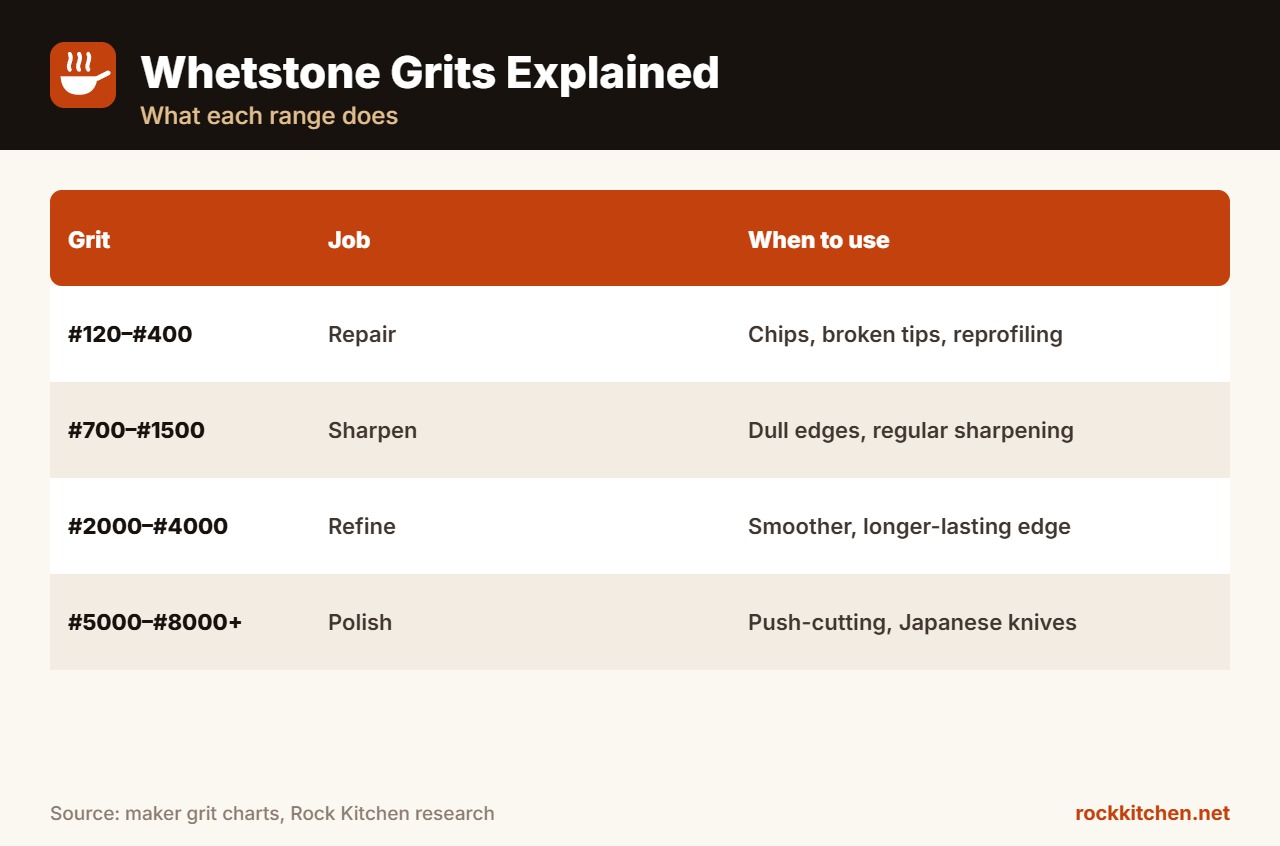
Pick the Right Grit
#3000–#5000 leaves a little tooth for slicing; #6000–#8000 polishes; #10000+ is for mirror edges.
Match Your Steel
Hard Japanese steels show the benefit of high grits more than soft German steels.
Soaking or Splash
Suehiro and Kitayama soak; Shapton is splash-and-go.
Keep It Clean
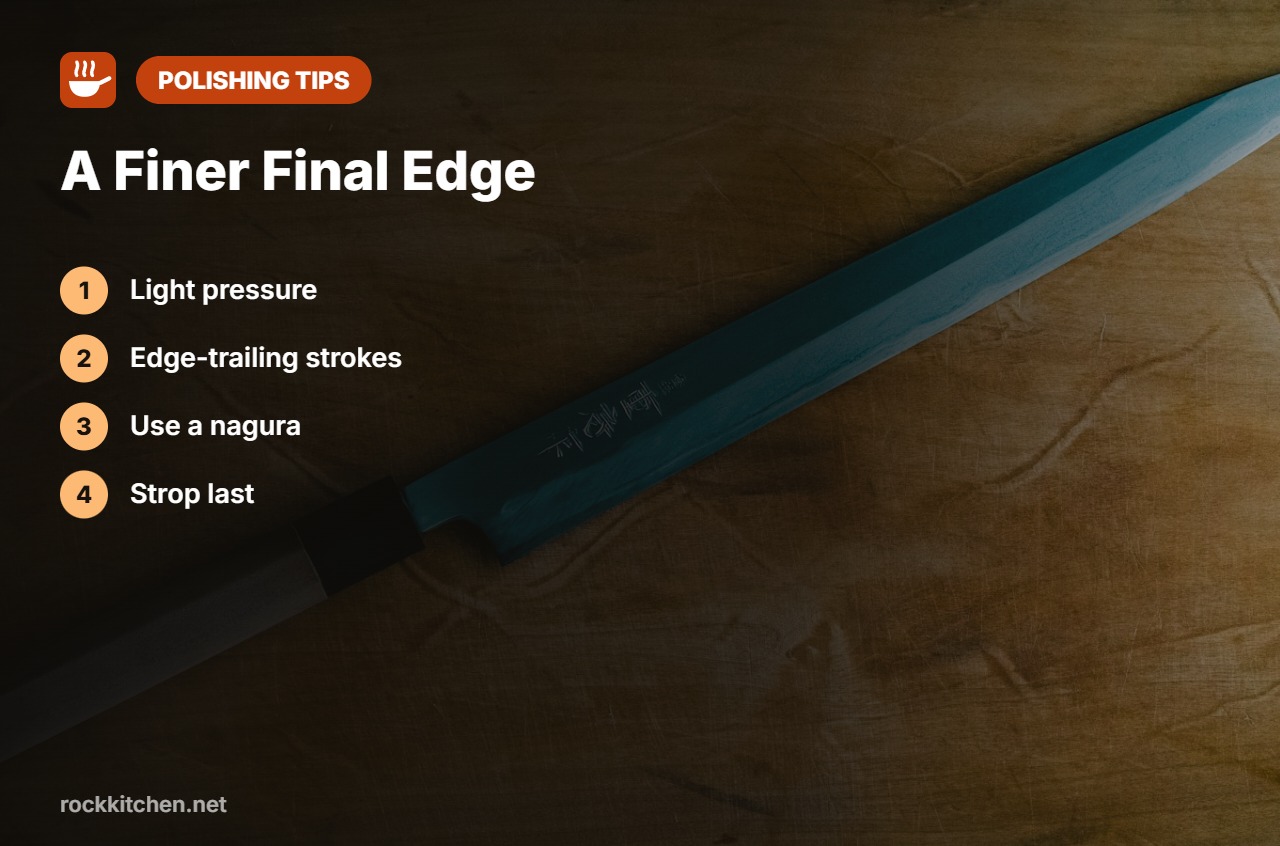
Finishing stones load with metal; rub with a nagura or flatten lightly.
Do Not Skip #1000
A finishing stone polishes an edge; it does not create one.
Tips for Sharpening on a Whetstone
- Soak soaking stones until bubbles stop; splash-and-go stones only need a spray of water.
- Hold a steady angle and count strokes per side so both bevels stay even.
- Raise a small burr along the whole edge before moving to the next grit.
- Flatten stones every few sessions with a lapping plate or coarse diamond plate.
- Rinse and dry the knife after sharpening, then let stones air-dry before storing.
Quick answers to common questions.
Frequently Asked Questions
What is the best finishing stone?
The Suehiro Rika #5000 for most cooks; the Kitayama #8000 for a finer polish.
What grit is a finishing stone?
Usually #3000 and above; #5000–#8000 is the sweet spot.
Do I need #12000?
Only if you want a mirror edge; most cooks stop at #8000.
Is a natural stone better?
Natural stones are lovely but vary; synthetic stones are more consistent.
Final Verdict
Our pick for the best finishing stone is the Suehiro Rika #5000. Choose the Kitayama #8000 for a finer polish or the King #6000 for value.
Related Guides
Keep sharpening smarter with these guides:
Prices and availability change often. Check the current listing on Amazon before you buy.