
As an Amazon Associate we earn from qualifying purchases. Learn more about our affiliate disclaimer.
JIS vs FEPA grit explains why a 1000 grit stone from Japan can feel different from a 1000 grit stone from Europe. JIS is the Japanese Industrial Standard used by most Japanese water stones. FEPA (F and P scales) is the European standard used for many abrasives and sandpapers. At the same number, the average particle size can differ.
Here is how to compare stones fairly.
Quick Answer: The JIS vs FEPA Grit
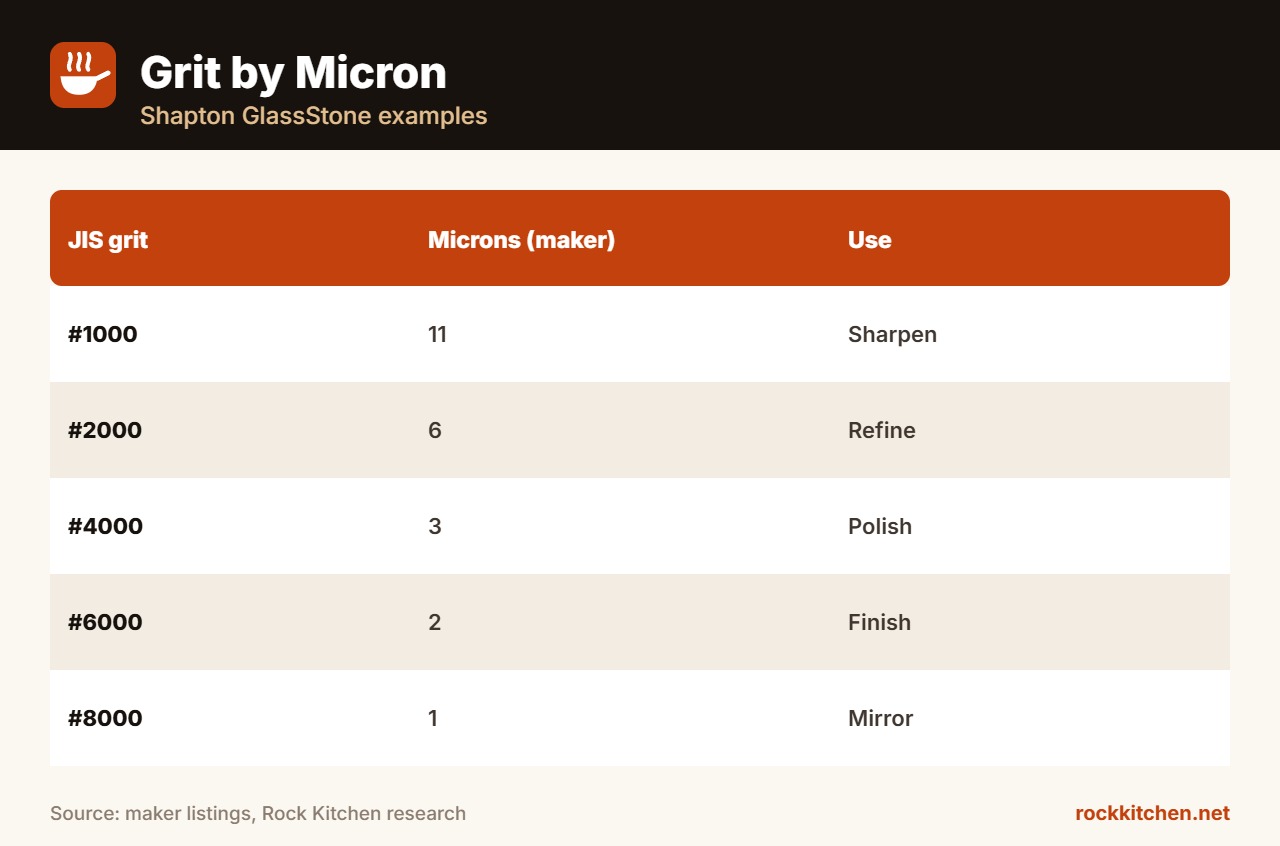
- Best Micron-Labeled 1000Shapton GlassStone #1000 (11 micron)
- Best Micron-Labeled 2000Shapton GlassStone #2000 (6 micron)
- Best Micron-Labeled 4000Shapton GlassStone #4000 (3 micron)
- Best Micron-Labeled 6000Shapton GlassStone #6000 (2 micron)
- Best JIS KuromakuShapton Kuromaku #1000 (K0702, Orange)
- Best Naniwa JISNaniwa Goken #1000 Medium Whetstone
Compare stones by micron size when the maker lists it, not just by the grit number. Japanese stones (JIS) such as Shapton GlassStone publish micron ratings that make comparison easy. Treat any cross-scale chart as approximate, because binders and stone hardness also change how a stone feels.
JIS vs FEPA Grit Comparison Table
| Product | Best For | Type | Key Feature | Buy |
|---|---|---|---|---|
| GlassStone 1000 | Best Micron-Labeled 1000 | Glass-backed stone | #1000, 11 µm, 8.25 x 2.75 in. | Check Price |
| GlassStone 2000 | Best Micron-Labeled 2000 | Glass-backed stone | #2000, 6 µm class | Check Price |
| GlassStone 4000 | Best Micron-Labeled 4000 | Glass-backed stone | #4000, 3 µm class | Check Price |
| GlassStone 6000 | Best Micron-Labeled 6000 | Glass-backed stone | #6000, 2 µm class | Check Price |
| Shapton Kuromaku 1000 | Best JIS Kuromaku | Ceramic whetstone | #1000 medium, 210 x 70 x 15 mm | Check Price |
| Naniwa Goken 1000 | Best Naniwa JIS | Ceramic whetstone | #1000, 210 x 70 x 15 mm | Check Price |
Our 6 Top Stones With Clear Grit Labels
Stones that publish microns or JIS grit.

1. Shapton GlassStone #1000 (11 micron)
1. 11 micron.
👍 Pros & Cons
Pros
- Splash-and-go convenience
- Long-lasting abrasive
- Glass backing keeps it usable when thin
Cons
- Hard feel takes getting used to
- Higher cost than Kuromaku #1000
📄 Detailed Review
- Grit: #1000 (11 micron class)
- Size: 8.25 x 2.75 in.
- Soaking: No need to soak
- Wear: Lasts longer than typical waterstones
Shapton’s GlassStone #1000 is in the 11 micron class, measures 8.25 x 2.75 inches and needs no soaking.
It is the most popular GlassStone grit and a good first stone in the series.

2. Shapton GlassStone #2000 (6 micron)
2. 6 micron.
👍 Pros & Cons
Pros
- Smooth step after #1000
- No soaking
Cons
- Fewer details in the listing
📄 Detailed Review
- Grit: #2000 (6 micron class)
- Type: WA
- Soaking: Not needed
The #2000 GlassStone sits in the 6 micron class. It bridges #1000 and #4000 for a refined working edge.
Use it if you want a slightly cleaner edge than #1000 without going to polish.

3. Shapton GlassStone #4000 (3 micron)
3. 3 micron.
👍 Pros & Cons
Pros
- Excellent first finishing grit
- Glass base stays flat
Cons
- Premium price
📄 Detailed Review
- Grit: #4000 (3 micron class)
- Material: Glass backing with ceramic abrasive
- Finish: Ultra fine
The #4000 GlassStone is a 3 micron class stone described as ultra fine, on Shapton’s glass backing.
For kitchen knives it is a finishing stone that keeps some bite.

4. Shapton GlassStone #6000 (2 micron)
4. 2 micron.
👍 Pros & Cons
Pros
- Polished edge on Japanese knives
- No soaking
Cons
- Little stock information
📄 Detailed Review
- Grit: #6000 (2 micron class)
- Size: 2.75 x 8.25 in.
The #6000 GlassStone sits in the 2 micron class and measures 2.75 x 8.25 inches.
It is a classic final stone for gyuto and santoku edges.

5. Shapton Kuromaku #1000 (K0702, Orange)
5. #1000.
👍 Pros & Cons
Pros
- Cuts fast enough to double as a coarse stone
- Case doubles as a stone holder
- Hugely popular first stone
Cons
- Single grit only
- Thin compared with soaking stones
📄 Detailed Review
- Grit: #1000 (medium)
- Size: 210 x 70 x 15 mm
- Item: K0702
- Use: Rough or medium sharpening
Shapton describes the orange K0702 as a #1000 medium stone with enough bite to be used for rough or medium sharpening.
It is one of the most recommended first whetstones for kitchen knives because it cuts quickly and stays relatively flat.

6. Naniwa Goken #1000 Medium Whetstone
6. Goken #1000.
👍 Pros & Cons
Pros
- Lower-cost entry to Naniwa
- Full 210 x 70 mm surface
- Suits stainless kitchen knives
Cons
- Thinner than Chosera stones
- No base mentioned
📄 Detailed Review
- Grit: #1000
- Size: 210 x 70 x 15 mm
- Uses: Kitchen knives, scissors, stainless blades, chisels
- Line: Goken (for professionals)
Goken is a newer Naniwa line aimed at professionals. This #1000 measures 210 x 70 x 15 mm and is listed for kitchen knives, scissors and stainless blades.
It is a good-value way to try Naniwa’s feel before investing in Chosera.
How We Chose the JIS vs FEPA Grit
For this jis vs fepa grit guide, we compared whetstones, diamond plates, oil stones and knife sharpeners listed on Amazon US by abrasive type, grit, size, hardness, angle control, speed and price, using product details from the listings and makers rather than a hands-on lab test. We then looked at common praise and complaints in buyer feedback for edge quality, wear, dishing, mess and learning curve. Prices and listings change often, so check the current listing before you buy.
Keep fingers behind the edge, sharpen on a stable non-slip base, keep metal swarf away from food, and wash knives before they touch food again, and follow USDA Food Safety and Inspection Service cleanliness guidance for kitchen hygiene. Our method is explained on the How We Test page.
JIS vs FEPA Grit: What to Know
JIS
Japanese standard used on most Japanese water stones.
FEPA
European standard (F for grains, P for coated abrasives).
Microns
Average particle size is the fairest comparison.
Brand variation
Binder and hardness change cutting feel.
Charts
Cross-scale charts are approximate guides.
Tips for Safer, Sharper Edges
- Hold a steady angle; consistency matters more than the exact number.
- Raise a small burr along the full edge before moving to a finer grit.
- Use light pressure on finishing grits.
- Flatten water stones often so they do not dish.
- Rinse and dry knives, then wipe stones clean after use.
Quick answers to common questions about jis vs fepa grit.
Frequently Asked Questions
Is JIS 1000 the same as FEPA 1000?
Not exactly; particle sizes differ.
Which standard do Japanese stones use?
Most use JIS.
What is a micron rating?
The average abrasive particle size in micrometers.
Why does my new 1000 feel coarser?
Grit scale, binder and stone hardness all affect feel.
Final Verdict
To understand jis vs fepa grit, compare microns; the Shapton GlassStone #1000 line lists them clearly.
Related Guides
Keep exploring knives and sharpening with these guides:
Prices and availability change often. Check the current listing on Amazon before you buy.