

As an Amazon Associate we earn from qualifying purchases. Learn more about our affiliate disclaimer.
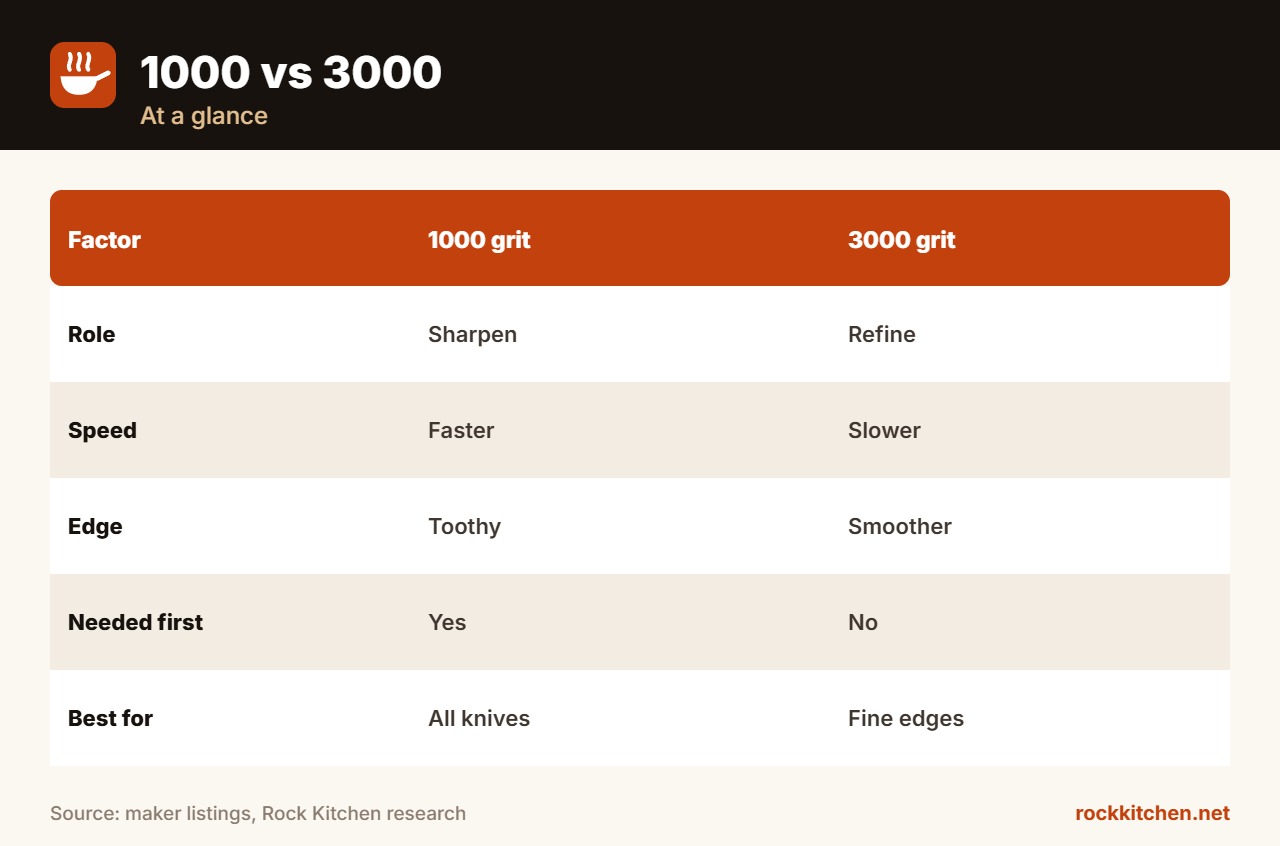
The 1000 vs 3000 grit whetstone choice is about sharpening versus refining. A 1000 grit stone is the main sharpening stone: it sets the edge and removes a dull or slightly damaged bevel. A 3000 grit stone refines that edge, makes it smoother and cleaner for push cuts, and is a step toward a polished finish.
Here is how to use them.
Quick Answer: The 1000 vs 3000 Grit Whetstone
- Best 1000/3000 ComboSuehiro Cerax 1000/3000 Combination Waterstone
- Best 1000 GritShapton Kuromaku #1000 (K0702, Orange)
- Best 3000 GritYoshihiro Toishi #3000 Whetstone
- Best Brand ComboShun Combination Whetstone, 1000 and 3000 Grit
- Best Value ComboMITSUMOTO SAKARI 1000/3000 Whetstone
- Best German Brand ComboWÜSTHOF Whetstone J 1000/3000
Buy a 1000 grit stone first; it handles most sharpening. Add 3000 grit if you want a smoother, longer-lasting kitchen edge, especially for Japanese knives. A 1000/3000 combination stone, like the Suehiro Cerax or Shun, is the easy way to get both.
1000 vs 3000 Grit Whetstone Comparison Table
| Product | Best For | Type | Key Feature | Buy |
|---|---|---|---|---|
| Suehiro Cerax 1000/3000 | Best 1000/3000 Combo | Combination soaking stone | #1000/#3000, 7-1/4 x 2-1/2 in. | Check Price |
| Shapton Kuromaku 1000 | Best 1000 Grit | Ceramic whetstone | #1000 medium, 210 x 70 x 15 mm | Check Price |
| Yoshihiro 3000 | Best 3000 Grit | Soaking stone | #3000, 8 x 2.85 x 0.9 in. | Check Price |
| Shun 1000/3000 | Best Brand Combo | Combination whetstone | 1000/3000 with rubber tray | Check Price |
| Mitsumoto Sakari 1000/3000 | Best Value Combo | Combination soaking stone | 1000/3000 white corundum on bamboo base | Check Price |
| Wüsthof 1000/3000 | Best German Brand Combo | Combination whetstone | 1000/3000, 7.9 x 2.4 x 1.2 in. | Check Price |
Our 6 Top 1000 and 3000 Grit Stones
Single stones and combination stones.

1. Suehiro Cerax 1000/3000 Combination Waterstone
1. Cerax.
👍 Pros & Cons
Pros
- Fast cutting and durable
- Excellent beginner grit pairing
Cons
- Shorter than 8 in. stones
- Soaking required
📄 Detailed Review
- Grits: #1000 / #3000
- Size: 7-1/4 x 2-1/2 in.
- Prep: Soak before use
Suehiro’s Cerax combination stone joins #1000 and #3000 in one 7-1/4 x 2-1/2 inch waterstone. Suehiro calls it fast cutting and durable.
The 1000/3000 pairing is ideal for home cooks who want a sharp but not over-polished edge.

2. Shapton Kuromaku #1000 (K0702, Orange)
2. Kuromaku.
👍 Pros & Cons
Pros
- Cuts fast enough to double as a coarse stone
- Case doubles as a stone holder
- Hugely popular first stone
Cons
- Single grit only
- Thin compared with soaking stones
📄 Detailed Review
- Grit: #1000 (medium)
- Size: 210 x 70 x 15 mm
- Item: K0702
- Use: Rough or medium sharpening
Shapton describes the orange K0702 as a #1000 medium stone with enough bite to be used for rough or medium sharpening.
It is one of the most recommended first whetstones for kitchen knives because it cuts quickly and stays relatively flat.

3. Yoshihiro Toishi #3000 Whetstone
3. Yoshihiro.
👍 Pros & Cons
Pros
- Wide 2.9 in. surface
- Made in Japan
Cons
- Higher price than mass-market #3000
📄 Detailed Review
- Grit: #3000
- Size: 8 x 2.85 x 0.9 in. (without base)
- Origin: Made in Japan
Yoshihiro’s professional-grade #3000 is 8 x 2.85 x 0.9 inches and made in Japan.
The extra width makes it easy to keep the whole edge on the stone.

4. Shun Combination Whetstone, 1000 and 3000 Grit
4. Shun.
👍 Pros & Cons
Pros
- Good middle-ground finish
- Stable tray
- Made for Shun knives
Cons
- High price per grit
📄 Detailed Review
- Grits: #1000 / #3000
- Brand: Shun (Kai, Japan)
- Includes: Rubber tray
- Size: About 7.5 x 3 in.
Shun’s 1000/3000 stone leaves a slightly toothier edge than the 1000/6000, which many cooks like for slicing tomatoes and onions.
It is a good fit if you prefer a working edge over a mirror polish.

5. MITSUMOTO SAKARI 1000/3000 Whetstone
5. Mitsumoto.
👍 Pros & Cons
Pros
- Bamboo base included
- Good beginner grit pairing
- Consistent slurry after soaking
Cons
- Soaking required
- Not a premium Japanese brand stone
📄 Detailed Review
- Grits: #1000 / #3000
- Abrasive: White corundum
- Base: Bamboo with non-slip pad
- Angle: Designed for 15°–20° work
This 1000/3000 stone uses white corundum and sits on a bamboo base with a non-slip pad.
It is a good-value first stone for 15–20 degree kitchen knives.

6. WÜSTHOF Whetstone J 1000/3000
6. WÜSTHOF.
👍 Pros & Cons
Pros
- Made for Wüsthof’s own knives
- Useful 1000/3000 pairing
Cons
- High price
📄 Detailed Review
- Grits: #1000 / #3000
- Brand: Wüsthof (Solingen, Germany)
- Size: 7.87 x 2.36 x 1.18 in.
- Weight: 1.9 lb
Wüsthof’s 1000/3000 stone gives its German knives a sharp edge with a fine finish.
It is the brand’s own choice if you want to match your knife set.
How We Chose the 1000 vs 3000 Grit Whetstone
For this 1000 vs 3000 grit whetstone guide, we compared whetstones, diamond plates, oil stones and knife sharpeners listed on Amazon US by abrasive type, grit, size, hardness, angle control, speed and price, using product details from the listings and makers rather than a hands-on lab test. We then looked at common praise and complaints in buyer feedback for edge quality, wear, dishing, mess and learning curve. Prices and listings change often, so check the current listing before you buy.
Keep fingers behind the edge, sharpen on a stable non-slip base, keep metal swarf away from food, and wash knives before they touch food again, and follow USDA Food Safety and Inspection Service cleanliness guidance for kitchen hygiene. Our method is explained on the How We Test page.
1000 vs 3000 Grit Whetstone: Key Differences
1000 grit
Main sharpening stone; raises a burr fast.
3000 grit
Refines scratches and smooths the edge.
Edge feel
1000 leaves a toothier edge; 3000 is cleaner.
Order
Always go 1000 first, then 3000.
Upkeep
Flatten both stones regularly.
Tips for Safer, Sharper Edges
- Hold a steady angle; consistency matters more than the exact number.
- Raise a small burr along the full edge before moving to a finer grit.
- Use light pressure on finishing grits.
- Flatten water stones often so they do not dish.
- Rinse and dry knives, then wipe stones clean after use.

Quick answers to common questions about 1000 vs 3000 grit whetstone.
Frequently Asked Questions
Do I need a 3000 grit whetstone?
Not required, but it gives a smoother edge.
Is 1000 grit enough for kitchen knives?
Yes for a working edge.
Can I skip from 1000 to 6000?
Yes, but 3000 makes the jump easier.
How long on each stone?
Until the burr forms on 1000; fewer strokes on 3000.
Final Verdict
For 1000 vs 3000 grit whetstone, start with a 1000 grit stone or get both in the Cerax 1000/3000.
Related Guides
Keep exploring knives and sharpening with these guides:
Prices and availability change often. Check the current listing on Amazon before you buy.