
As an Amazon Associate we earn from qualifying purchases. Learn more about our affiliate disclaimer.
8000 grit vs 6000 grit is a choice between two finishing stones. A 6000 grit stone gives a fine, smooth edge that still keeps a little bite for slicing tomatoes and onions. An 8000 grit stone goes further toward a mirror polish and a very refined edge, best for push-cutting, sushi and hard Japanese steel.
Here is which one makes sense.
Quick Answer: The 8000 Grit vs 6000 Grit
- Best 6000 GritKING #6000 Finishing Whetstone
- Best 8000 GritShapton GlassStone #8000 (1 micron)
- Best Fast 6000Shapton GlassStone #6000 (2 micron)
- Best Naniwa 8000Naniwa Pure White #8000 Super Finishing Stone
- Best 3000/8000 ComboKota Japan 3000/8000 Whetstone
- Best 1000/6000 ComboKing KDS 1000/6000 Grit Double-Sided Whetstone
For most kitchen knives, 6000 grit is the sweet spot: refined but still grippy. Choose 8000 grit if you love a mirror finish, sharpen hard Japanese knives and push-cut more than you slice. A King 6000 is a classic value pick; Shapton GlassStone #8000 is a fast, consistent 8000.
8000 Grit vs 6000 Grit Comparison Table
| Product | Best For | Type | Key Feature | Buy |
|---|---|---|---|---|
| King 6000 | Best 6000 Grit | Finishing stone | #6000, made in Japan | Check Price |
| GlassStone 8000 | Best 8000 Grit | Glass-backed stone | #8000, 1 µm class | Check Price |
| GlassStone 6000 | Best Fast 6000 | Glass-backed stone | #6000, 2 µm class | Check Price |
| Naniwa Pure White 8000 | Best Naniwa 8000 | Finishing stone | #8000 finishing after medium sharpening | Check Price |
| Kota Japan 3000/8000 | Best 3000/8000 Combo | Combination stone | 3000/8000 aluminum oxide + silicone holder | Check Price |
| King KDS 1000/6000 | Best 1000/6000 Combo | Combination water stone | Harder King combination stone, soak before use | Check Price |
Our 6 Top 6000 and 8000 Grit Stones
Finishing stones and combos.

1. King #6000.
👍 Pros & Cons
Pros
- Affordable dedicated finishing stone
- Made in Japan
Cons
- Soft; can gouge if you press too hard
📄 Detailed Review
- Grit: #6000
- Origin: Made in Japan
- Note: No plastic compounds
King’s single #6000 finishing stone is made in Japan without plastic compounds.
It is an inexpensive way to add a polishing step to any #1000 stone.

2. Shapton GlassStone #8000 (1 micron)
2. Shapton Glass.
👍 Pros & Cons
Pros
- Fine polish with no soaking
- Stays flat on glass backing
Cons
- Overkill for soft stainless knives
📄 Detailed Review
- Grit: #8000 (1 micron class)
- Size: 2.75 x 8.25 in.
The #8000 GlassStone is in the 1 micron class. It is a high-polish stone that works straight from a spray of water.
Choose it as the last step for single-bevel and hard-steel knives.

3. Shapton GlassStone #6000 (2 micron)
3. Shapton Glass.
👍 Pros & Cons
Pros
- Polished edge on Japanese knives
- No soaking
Cons
- Little stock information
📄 Detailed Review
- Grit: #6000 (2 micron class)
- Size: 2.75 x 8.25 in.
The #6000 GlassStone sits in the 2 micron class and measures 2.75 x 8.25 inches.
It is a classic final stone for gyuto and santoku edges.

4. Naniwa Pure White #8000 Super Finishing Stone
4. Pure White.
👍 Pros & Cons
Pros
- High-grit finish from a major Japanese maker
- Good step after a #1000–#3000
- Produces a polished bevel
Cons
- Limited stock at times
- Few details in the listing
📄 Detailed Review
- Grit: #8000
- Model: IF-0001
- Use: Finishing after medium sharpening
- Brand: Naniwa (Japan)
The Pure White #8000 is Naniwa’s super-finishing stone, listed for use after medium sharpening.
It suits cooks who want a polished, refined edge without jumping to five-figure grits.

5. Kota Japan 3000/8000 Whetstone
5. Kota Japan.
👍 Pros & Cons
Pros
- Two finishing grits in one stone
- Silicone holder included
Cons
- Needs a #1000 stone before it
📄 Detailed Review
- Grits: #3000 / #8000
- Abrasive: Aluminum oxide (corundum)
- Holder: Non-slip silicone
Kota Japan’s stone pairs #3000 for refining and #8000 for polishing, made from aluminum oxide with a silicone holder.
It is an affordable way to add both finishing grits.

6. King KDS 1000/6000 Grit Double-Sided Whetstone
6. King KDS.
👍 Pros & Cons
Pros
- Harder than the classic KW65 stone
- Two useful grits in one block
- Long-trusted Japanese brand
Cons
- Needs soaking before use
- Needs flattening over time
📄 Detailed Review
- Grits: 1000 and 6000 (listing)
- Type: Soaking water stone
- Base: Plastic stand (listing)
King’s firmer combo stone.
The reviewed stone.
How We Chose the 8000 Grit vs 6000 Grit
For this 8000 grit vs 6000 grit guide, we compared whetstones, diamond plates, oil stones and knife sharpeners listed on Amazon US by abrasive type, grit, size, hardness, angle control, speed and price, using product details from the listings and makers rather than a hands-on lab test. We then looked at common praise and complaints in buyer feedback for edge quality, wear, dishing, mess and learning curve. Prices and listings change often, so check the current listing before you buy.
Keep fingers behind the edge, sharpen on a stable non-slip base, keep metal swarf away from food, and wash knives before they touch food again, and follow USDA Food Safety and Inspection Service cleanliness guidance for kitchen hygiene. Our method is explained on the How We Test page.
8000 Grit vs 6000 Grit: Key Differences
Polish
8000 gives a brighter, more mirror-like finish.
Bite
6000 keeps slightly more tooth for slicing.
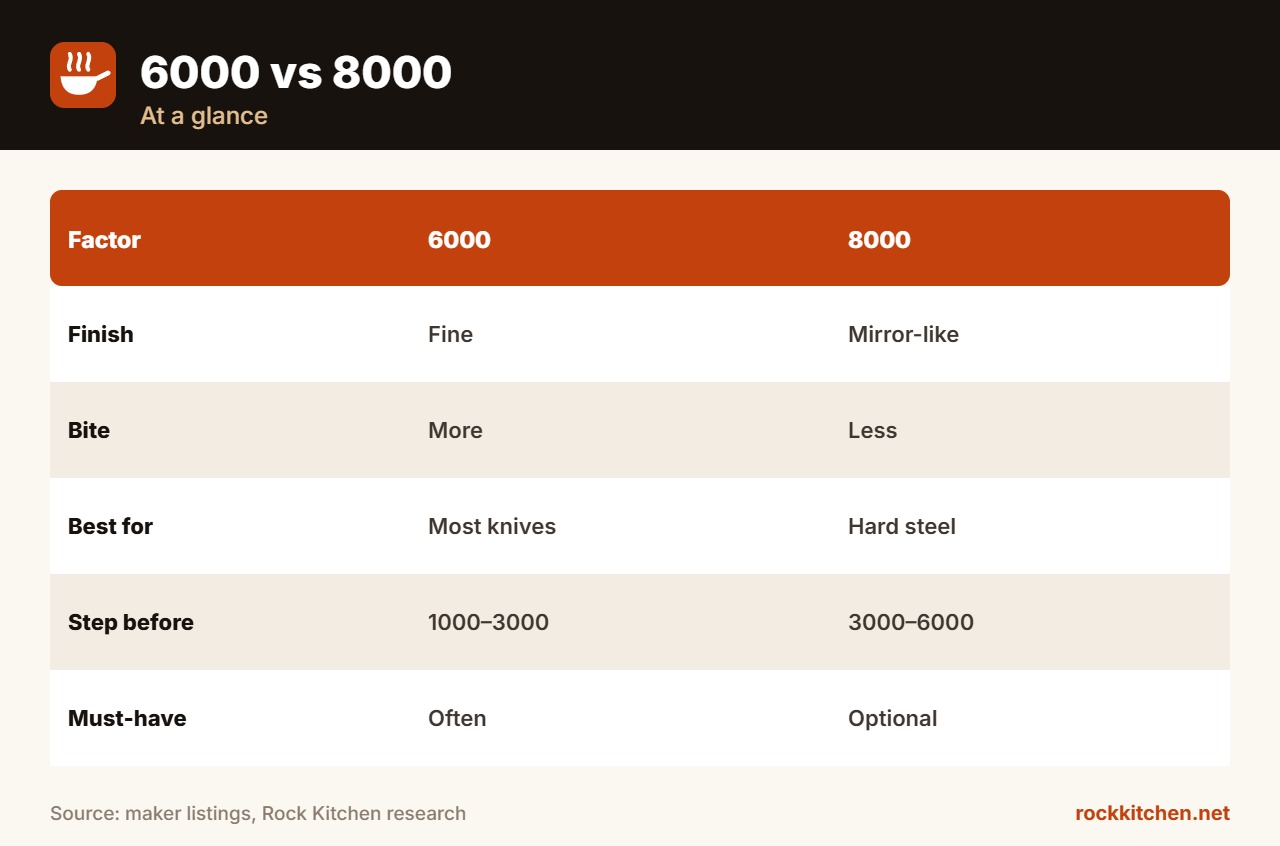
Steel
Harder Japanese steels show the most benefit at 8000.
Time
8000 takes longer if you skip 3000 or 6000.
Need
Most home cooks only need 6000.
Tips for Safer, Sharper Edges
- Hold a steady angle; consistency matters more than the exact number.
- Raise a small burr along the full edge before moving to a finer grit.
- Use light pressure on finishing grits.
- Flatten water stones often so they do not dish.
- Rinse and dry knives, then wipe stones clean after use.
Quick answers to common questions about 8000 grit vs 6000 grit.
Frequently Asked Questions
Is 8000 grit too fine for kitchen knives?
Not too fine, but the extra polish may reduce slicing bite.
Do I need both 6000 and 8000?
No; pick one finishing stone.
Can I go 1000 to 8000?
You can, but it takes longer; a middle grit helps.
Does 8000 grit make knives sharper?
It makes the edge more refined, which feels sharper on push cuts.
Final Verdict
In 8000 grit vs 6000 grit, the King 6000 suits most cooks and the Shapton Glass 8000 suits mirror-edge fans.
Related Guides
Keep exploring knives and sharpening with these guides:
Prices and availability change often. Check the current listing on Amazon before you buy.