

As an Amazon Associate we earn from qualifying purchases. Learn more about our affiliate disclaimer.
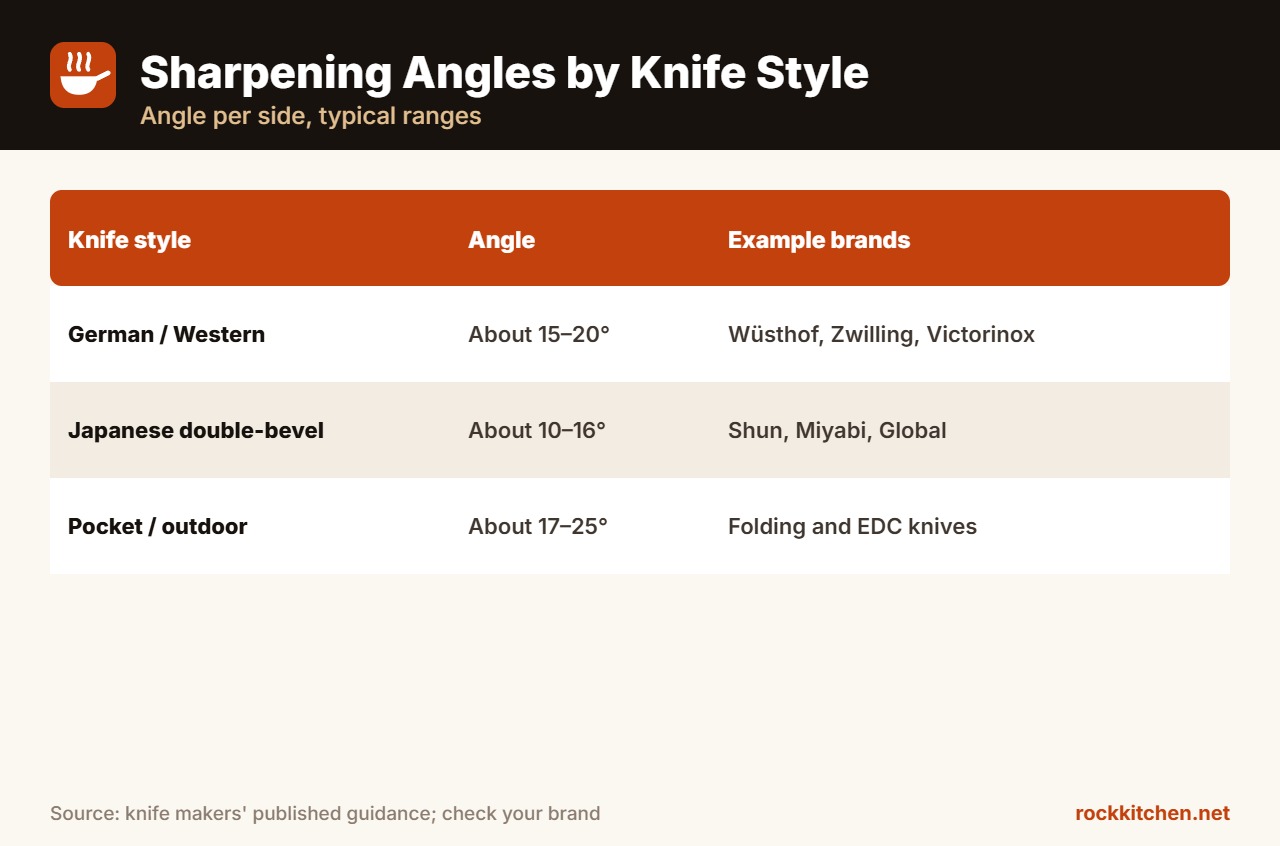
The best way to sharpen Japanese knives is on water stones at a low angle, about 10–16° per side, with light pressure. Japanese blades use hard, thin steel that can chip in carbide pull-throughs or fast electric wheels, so stones or gentle ceramic tools protect the edge.
Below we explain the method and compare six stones and gentle sharpeners on Amazon US by grit, hardness and reviews.
Quick Answer: The Best Way to Sharpen Japanese Knives
- Best StoneShapton Kuromaku #1000 (K0702, Orange)
- Best for ShunShun Combination Whetstone, 1000 and 6000 Grit
- Best Budget ComboKING KW65 1000/6000 Grit Combination Whetstone with Base
- Best FinishingKota Japan 3000/8000 Whetstone
- Easiest Gentle OptionMinoSharp 3 Sharpener, Black/Red
- Best Honing RodMac Knife Ceramic Honing Rod, 8-1/2 Inch
Use a #1000 stone, then #3000–#6000, at about 15°. Shapton’s Kuromaku #1000 is our top stone for hard Japanese steel, Shun’s 1000/6000 is made for Shun knives, King’s KW65 is the classic budget combo, Kota Japan’s 3000/8000 adds a polish, MinoSharp 3 is the gentle easy option and Mac’s ceramic rod keeps edges keen.
Best Way to Sharpen Japanese Knives Comparison Table
| Product | Best For | Type | Key Feature | Buy |
|---|---|---|---|---|
| Shapton Kuromaku 1000 | Best Stone | Ceramic whetstone | #1000 medium, 210 x 70 x 15 mm | Check Price |
| Shun 1000/6000 | Best for Shun | Combination whetstone | 1000/6000 with rubber tray | Check Price |
| KING KW65 | Best Budget Combo | Synthetic combination waterstone | 1000/6000 grit with plastic base | Check Price |
| Kota Japan 3000/8000 | Best Finishing | Combination stone | 3000/8000 aluminum oxide + silicone holder | Check Price |
| MinoSharp 3 | Easiest Gentle Option | Water wheel sharpener | Three ceramic wheels, water bath | Check Price |
| Mac Ceramic Rod 8.5" | Best Honing Rod | Ceramic honing rod | Compact rod from a Japanese knife maker | Check Price |
6 Tools for Sharpening Japanese Knives
Ranked by edge quality and safety for hard steel.

1. Shapton Kuromaku #1000 (K0702, Orange)
1. Hard ceramic.
👍 Pros & Cons
Pros
- Cuts fast enough to double as a coarse stone
- Case doubles as a stone holder
- Hugely popular first stone
Cons
- Single grit only
- Thin compared with soaking stones
📄 Detailed Review
- Grit: #1000 (medium)
- Size: 210 x 70 x 15 mm
- Item: K0702
- Use: Rough or medium sharpening
Shapton describes the orange K0702 as a #1000 medium stone with enough bite to be used for rough or medium sharpening.
It is one of the most recommended first whetstones for kitchen knives because it cuts quickly and stays relatively flat.

2. Shun Combination Whetstone, 1000 and 6000 Grit
2. 1000/6000.
👍 Pros & Cons
Pros
- Made for Shun’s thin, hard Japanese edges
- Sharpen and polish in one stone
- Stable rubber tray
Cons
- Only 38 ratings
- Pricey for a combination stone
📄 Detailed Review
- Grits: #1000 / #6000
- Brand: Shun (Kai, Japan)
- Includes: Rubber tray
- Size: About 7.5 x 3.5 in. with tray
Shun’s own 1000/6000 stone is designed to keep its hard VG-MAX steel knives at their factory sharpness.
Use the #1000 side to sharpen and the #6000 side to polish.

3. KING KW65 1000/6000 Grit Combination Whetstone with Base
3. Classic.
👍 Pros & Cons
Pros
- The classic Japanese starter stone
- Thousands of ratings
- Builds the skills you need before a natural stone
Cons
- Soaking stone
- Wears and dishes faster than hard stones
📄 Detailed Review
- Grits: 1000 / 6000
- Size: 8 x 2.5 x 1 in.
- Base: Plastic stand
- Made in: Japan
Most sharpeners learn on a 1000/6000 synthetic before buying a natural stone. The King KW65 is the most common choice.
Use the 1000 side to set the edge, then move to a natural finishing stone when your angle is consistent.

4. 3000/8000.
👍 Pros & Cons
Pros
- Two finishing grits in one stone
- Silicone holder included
Cons
- Needs a #1000 stone before it
📄 Detailed Review
- Grits: #3000 / #8000
- Abrasive: Aluminum oxide (corundum)
- Holder: Non-slip silicone
Kota Japan’s stone pairs #3000 for refining and #8000 for polishing, made from aluminum oxide with a silicone holder.
It is an affordable way to add both finishing grits.

5. MinoSharp 3 Sharpener, Black/Red
5. Ceramic wheels.
👍 Pros & Cons
Pros
- About 650 ratings, 4.6 average
- Gentle ceramic
- Designed for Global knives
Cons
- Slower than electric
- Needs water
📄 Detailed Review
- Wheels: 3 ceramic
- Use: Japanese knives
- Brand: MinoSharp (Global)
A gentle water-wheel sharpener made for Japanese blades.
Best gentle option for Japanese knives.

6. Mac Knife Ceramic Honing Rod, 8-1/2 Inch
6. Mac.
👍 Pros & Cons
Pros
- About 390 ratings, 4.6 average
- Made for Japanese knives
- Compact
Cons
- Short for long slicers
- Pricier
📄 Detailed Review
- Length: 8.5 in.
- Abrasive: Ceramic
- Brand: Mac (Japan)
Mac’s compact ceramic rod suits Japanese gyutos.
Best for Japanese knives.
How We Chose the Best Way to Sharpen Japanese Knives
To build this guide to the best way to sharpen japanese knives, we compared whetstones, whetstone kits and sharpening accessories sold on Amazon US by grit range, abrasive type, stone size, soaking needs, bases, flattening tools and angle aids. We then read patterns in verified-buyer reviews for cutting speed, dishing, flatness, stability and ease of use, and noted when ratings are shared across variants or when the evidence is thin.
Wash knives after sharpening to remove metal swarf before they touch food, and keep cutting tools clean, following USDA Food Safety and Inspection Service cleanliness guidance. Our method is explained on the How We Test page; this is a research-based guide, not a lab test.
Whetstone Method for Japanese Knives
Angle
About 10–16° per side; check the maker’s spec.
Pressure
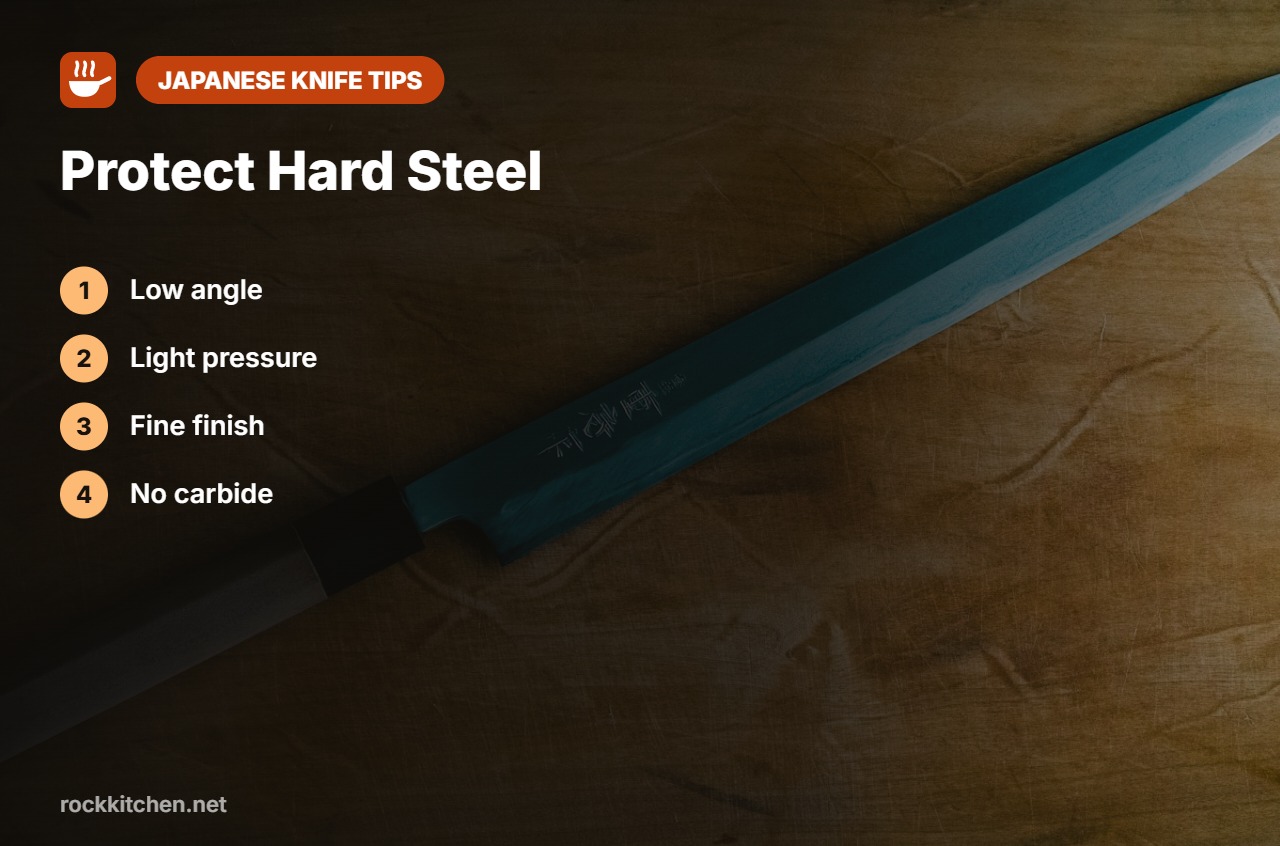
Light pressure avoids micro-chips in hard steel.
Grits
#1000 to sharpen, #3000–#6000 to refine.
Single Bevel
Single-bevel knives need a different, one-sided method.
Avoid
Skip carbide pull-throughs and coarse steel rods.
Tips for Sharpening on a Whetstone
- Soak soaking stones until bubbles stop; splash-and-go stones just need water on top.
- Hold a steady angle and count strokes per side.
- Raise a small burr along the whole edge before changing grit.
- Flatten stones every few sessions.
- Rinse and dry the knife, then let stones air-dry.
Quick answers to common questions.
Frequently Asked Questions
What is the best way to sharpen Japanese knives?
Water stones at about 10–16° with light pressure.
Can I use a pull-through on Japanese knives?
Avoid carbide pull-throughs; they can chip hard steel.
What grit for Japanese knives?
#1000 then #3000–#6000; #8000 for a polish.
How do I sharpen a single-bevel knife?
Sharpen the bevel side, then lightly flatten the back.
Final Verdict
The best way to sharpen Japanese knives is a fine water stone such as the Shapton Kuromaku #1000, followed by a finer stone.
Related Guides
Keep sharpening smarter with these guides:
Prices and availability change often. Check the current listing on Amazon before you buy.