
As an Amazon Associate we earn from qualifying purchases. Learn more about our affiliate disclaimer.
The best diamond plate for knives is not the coarsest one you can find. For kitchen knives you want a plate fine enough to sharpen routinely, usually 600 to 1200 grit, with a surface wide and flat enough to keep a chef’s knife stable.
This guide focuses on sharpening rather than flattening. We compared fine and extra-fine plates from DMT, SHARPAL and Atoma on grit, size, surface type and the kind of edge they leave, so you can choose a plate that becomes your everyday sharpener.
Quick Answer: The Best Diamond Plate for Knives
- Best OverallDMT D8F Dia-Sharp 8-Inch Fine Bench Stone
- Best for Hard SteelsSHARPAL 168H Large 325/1000 Diamond Stone
- Best Japanese PlateAtoma #600 Fine Diamond Plate with Base
- Best Refining PlateDMT D8E Dia-Sharp 8-Inch Extra Fine Bench Stone
- Best CompactDMT D6EF 6-Inch Dia-Sharp Fine/Extra-Fine
- Best BudgetSHARPAL 156N Double-Sided Diamond Stone, 6 x 2.5 in.
The DMT D8F is the best diamond plate for knives overall because its fine continuous surface is ideal for routine sharpening. The SHARPAL 168H is the pick for hard super-steel blades.
Best Diamond Plate for Knives Comparison Table
| Product | Best For | Type | Key Feature | Buy |
|---|---|---|---|---|
| DMT D8F (Fine) | Best Overall | Diamond bench stone | Continuous fine diamond for regular sharpening | Check Price |
| SHARPAL 168H | Best for Hard Steels | Two-sided diamond plate | 325 (45 µm) / 1000 (15 µm), 8 x 3 in. | Check Price |
| Atoma #600 | Best Japanese Plate | Diamond plate | #600 fine diamond on a 10.6 x 4.3 in. base | Check Price |
| DMT D8E (Extra Fine) | Best Refining Plate | Diamond bench stone | Extra fine continuous diamond for refining | Check Price |
| DMT D6EF | Best Compact | Two-sided diamond plate | Fine + extra-fine, compact 6 in. | Check Price |
| SHARPAL 156N | Best Budget | Two-sided diamond plate | Compact 325 / 1200 with angle guide | Check Price |
The 6 Best Diamond Plates for Kitchen Knives
These are the plates we would actually sharpen with week to week; the best diamond plate for knives in your kitchen depends on blade length and steel.

1. DMT D8F Dia-Sharp 8-Inch Fine Bench Stone
1. An 8 in. continuous fine diamond surface that handles chef’s knives, paring knives and tips. Our best diamond plate for knives for routine sharpening.
👍 Pros & Cons
Pros
- Fine grit is right for routine kitchen-knife sharpening
- Flat surface that will not dish over time
- Works on large blades and fine-pointed tools
Cons
- Single grit; you still want a finishing stone
- Not a fast reprofiling surface
📄 Detailed Review
- Surface: Continuous fine monocrystalline diamond
- Length: 8 in.
- Base: 4 non-skid rubber feet
- Use: Dry or with water
- Origin: Made in USA
The fine D8F is the DMT bench stone most cooks actually use week to week. It repairs mild dullness, sets a clean burr and works with just a splash of water.
It is a good partner for a coarse DMT or a #3000–#6000 waterstone, giving a durable middle step that never needs flattening.

2. SHARPAL 168H Large 325/1000 Diamond Stone
2. A large 8 x 3 in. plate with 325 and 1000 grit, listed for super steels like M390 and Elmax that glaze ordinary stones.
👍 Pros & Cons
Pros
- Large surface for stable angle control
- Handles very hard “super steels”
- Coarse side restores dull edges quickly
Cons
- 1000 grit edge benefits from a finer stone
- Newer model with fewer long-term owner reports
📄 Detailed Review
- Grits: 325 (45 µm) / 1000 (15 µm)
- Size: 8 x 3 in. (201 x 75 mm)
- Steels: Listed for CPM-series, M390, Elmax
- Uses: Knives plus chisels and plane blades
The 168H is a large 8 by 3 inch plate with coarse 325 grit (45 micron) and extra-fine 1000 grit (15 micron). SHARPAL positions it for hard powder steels such as CPM-series, M390 and Elmax.
For a kitchen with modern Japanese or premium Western knives, it is a sturdy primary plate.

3. Atoma #600 Fine Diamond Plate with Base
3. Atoma’s #600 on a 10.6 x 4.3 in. base, fine enough to sharpen and large enough for long gyutos.
👍 Pros & Cons
Pros
- Fine enough to sharpen kitchen knives directly
- Large base gives a wide, stable working surface
- Flattens finishing stones without leaving deep scratches
Cons
- Slower than #400 for heavy flattening
- Bigger footprint to store
📄 Detailed Review
- Grit: #600 fine
- Type: Diamond
- Size: 10.6 x 4.3 x 0.6 in. (with base)
- Typical use: General kitchen knives, carpenter blades
The #600 sits in the middle of the Atoma range. It is listed for general kitchen knives and carpenter blades, which makes it the most knife-friendly plate in the family.
Many owners use it to keep finishing stones (#5000 and up) flat because it leaves a smoother surface than the #400 while still cutting quickly.

4. DMT D8E Dia-Sharp 8-Inch Extra Fine Bench Stone
4. Extra-fine continuous diamond that turns a fine edge into a keen, slightly toothy slicer.
👍 Pros & Cons
Pros
- Refines an edge to a keen, toothy finish
- Excellent for hard and powder steels
- Low maintenance compared with soft finishing stones
Cons
- Too fine to fix damaged edges
- Leaves a less polished look than a high-grit waterstone
📄 Detailed Review
- Surface: Continuous extra fine diamond
- Length: 8 in.
- Base: Non-skid rubber feet
- Use: Dry or with water
- Origin: Made in USA
The extra fine D8E is DMT’s refining surface. It brings an edge from fine-diamond sharpness to a cleaner, keener finish while keeping the low-maintenance diamond format.
Cooks who prefer a slightly toothy edge for slicing tomatoes and crusty bread often stop here instead of polishing further.

5. DMT D6EF 6-Inch Dia-Sharp Fine/Extra-Fine
5. Fine and extra-fine on one 6 in. plate, a tidy drawer-size option for paring and utility knives.
👍 Pros & Cons
Pros
- Two refining grits for regular maintenance
- Compact size stores in a drawer
- Made in the USA
Cons
- Short for long chef’s knives and slicers
- No coarse side for repairs
📄 Detailed Review
- Grits: Fine / Extra-fine
- Length: 6 in.
- Use: Dry or with water
- Origin: Made in USA
The D6EF is a compact two-sided Dia-Sharp with fine and extra-fine diamond. It is designed for sharpening, polishing and refining knives and fine tools.
Its 6-inch length suits paring and utility knives best; long gyuto owners will prefer an 8-inch plate.

6. SHARPAL 156N Double-Sided Diamond Stone, 6 x 2.5 in.
6. A compact 325/1200 grit plate with an angle guide and box base at an easy price.
👍 Pros & Cons
Pros
- Same grit pair as the 162N at a smaller size
- Easy to store in a drawer
- Good value starter plate
Cons
- Short surface for 8–10 in. chef’s knives
- No fine polishing grit
📄 Detailed Review
- Grits: 325 (45 µm) / 1200 (12 µm)
- Size: 6 x 2.5 in.
- Base: 0.33 in. stainless steel
- Extras: Storage box base, angle guide
The 156N is the compact sibling of the 162N, with the same 325 and 1200 grit diamond on a 6 by 2.5 inch steel plate.
It suits small kitchens, paring and petty knives, and anyone who wants a diamond plate that fits in a utensil drawer.
How We Chose the Best Diamond Plate for Knives
To choose the best diamond plate for knives, we focused on grits in the 600–1200 range, plate length relative to common 8–10 in. kitchen knives, surface type (continuous vs. interrupted) and how well owners say the plate handles tips. We compared manufacturer micron ratings so the grit comparison is apples to apples.
Diamond abrasives are widely used in industry for cutting hard materials, as the U.S. Geological Survey industrial diamond data explains. After sharpening, wash knives to remove fine metal particles, as recommended in USDA Food Safety and Inspection Service cleanliness guidance. See our How We Test page for our full approach.
Buying Guide: How to Choose the Best Diamond Plate for Knives
Pick a Sharpening Grit, Not a Repair Grit
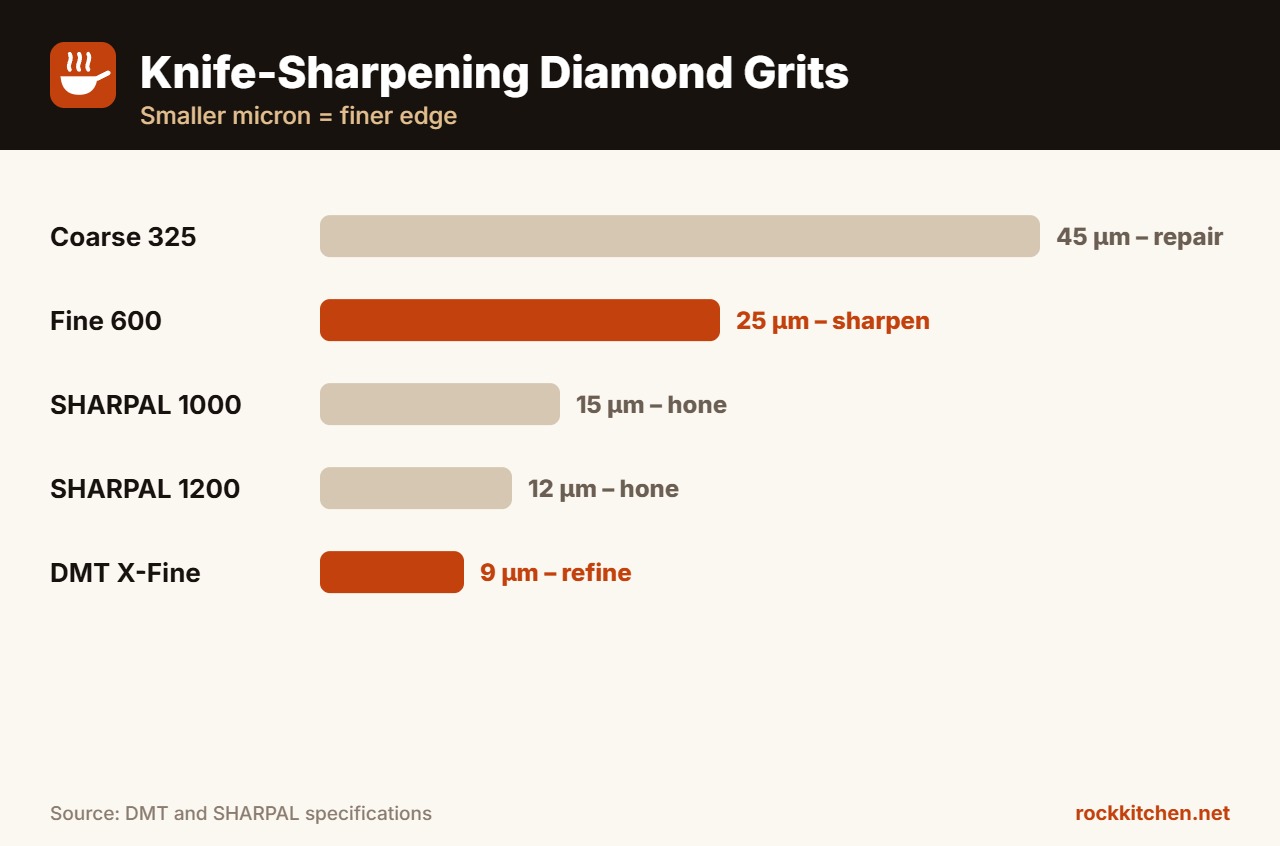
Fine (around 600 grit / 25 µm) and extra-fine (1000–1200 grit / 9–15 µm) plates are where kitchen knives get sharp. Coarse plates are for chips and reshaping.
Match Length to Your Longest Knife
An 8 in. plate handles most chef’s knives. Long slicers and 240 mm gyutos are easier on larger plates such as the 10.6 in. Atoma.
Continuous Surfaces for Tips
A continuous surface lets the tip glide without catching, which matters for paring knives and petty knives.
Hard Steels Need Diamond
Powder and super steels resist ordinary abrasives. Diamond cuts them efficiently, which is why many owners of modern Japanese knives keep a fine diamond plate.
Finish With a Strop or Fine Stone
Diamond leaves a toothy edge. A few passes on a #3000–#6000 stone or a leather strop give a smoother finish if you prefer it.
How to Sharpen a Chef’s Knife on a Diamond Plate
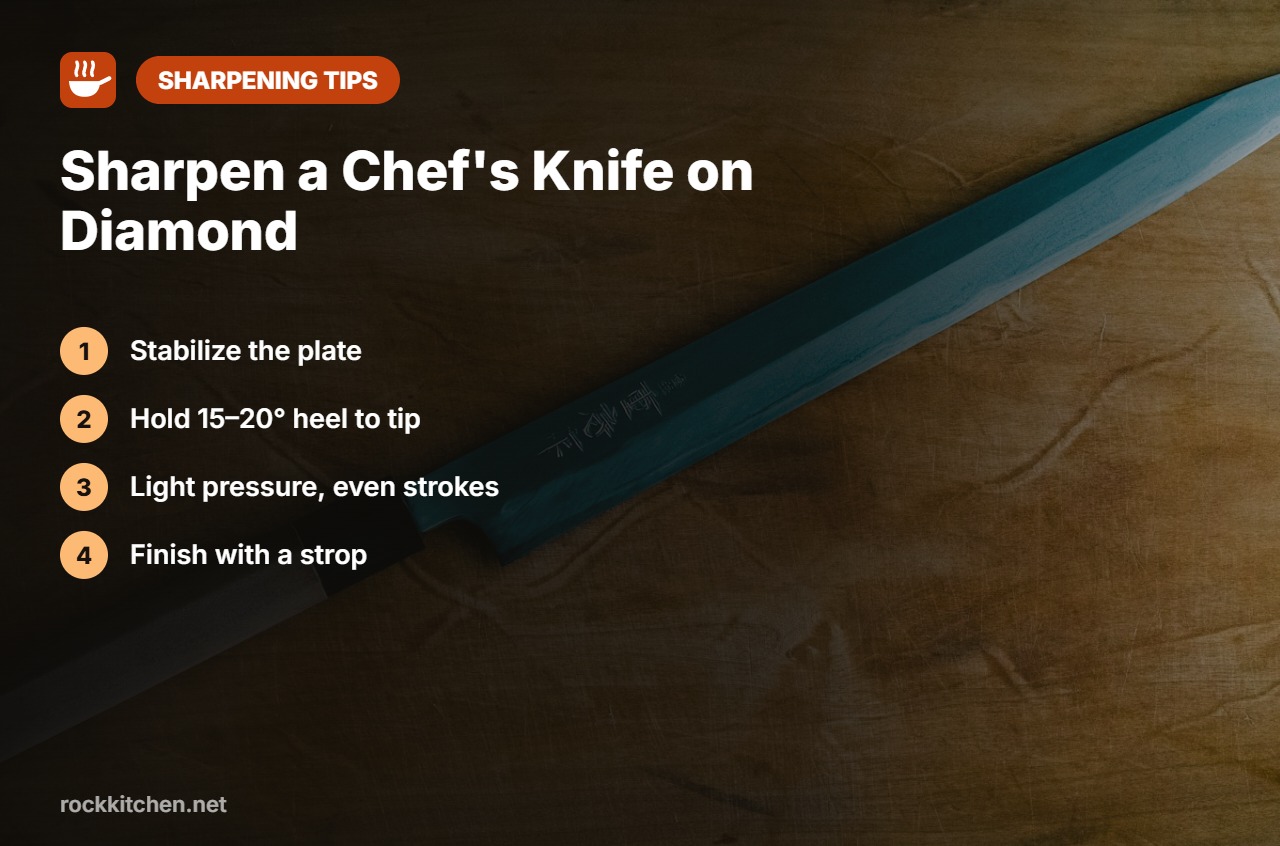
- Set the plate on a damp towel or non-slip base.
- Wet the surface or use it dry as the maker allows.
- Hold about 15–20° and sweep from heel to tip.
- Use light pressure and count strokes per side.
- Finish with a few edge-trailing strokes or a strop.
Answers to common questions about choosing the best diamond plate for knives.
Frequently Asked Questions
What grit diamond plate is best for kitchen knives?
The best diamond plate for knives is usually fine to extra-fine: about 600–1200 grit (25–9 microns). Keep a coarse plate only for repairs.
Will a diamond plate damage my knives?
Not with light pressure and a steady angle. Diamond removes metal quickly, so avoid heavy pressure.
Can I use water on a diamond plate?
Yes. DMT plates can be used dry or with water, and most makers say no oil is needed.
Do I still need a whetstone?
Not necessarily, but a fine waterstone or strop gives a more polished edge if you want one.
Final Verdict
Our final pick for the best diamond plate for knives is the DMT D8F. Choose the SHARPAL 168H for super steels or the Atoma #600 for long Japanese blades.
Related Guides
Keep building your sharpening setup with these guides:
- Best Diamond Sharpening Stone 2026
- Best Japanese Whetstone for Beginners 2026
- How We Test and Research Kitchen Gear
- All Knife Sharpening Guides
Prices and availability change often. Check the current listing on Amazon before you buy.