
As an Amazon Associate we earn from qualifying purchases. Learn more about our affiliate disclaimer.
The best Japanese whetstone for beginners is a stone that forgives small mistakes, covers the grits you actually need and does not punish you with long prep. For most new sharpeners that means a #1000 stone, ideally paired with a #3000–#6000 finishing side.
We compared popular starter stones from King, Shapton, Suehiro and Mitsumoto Sakari, focusing on grit pairing, bases and angle aids, soaking needs and how much flattening they require. You will also find a simple first-session routine and answers to common beginner questions.
Quick Answer: The Best Japanese Whetstone for Beginners
- Best OverallKING KW65 1000/6000 Combination Whetstone
- Best With Angle GuideKING Whetstone Starter Set (1000/6000 + Angle Holder)
- Best No-Soak KitShapton Kuromaku A-Set (#1000 + #5000)
- Best 1000/3000Suehiro Cerax 1000/3000 Combination Waterstone
- Best BudgetMITSUMOTO SAKARI 1000/3000 Whetstone
- Best Single StoneShapton Kuromaku #1000 (K0702, Orange)
The King KW65 1000/6000 is the best Japanese whetstone for beginners on a budget because one stone covers sharpening and finishing. The King starter set adds an angle holder, and Shapton’s A-set is the no-soak upgrade.
Best Japanese Whetstone for Beginners Comparison Table
| Product | Best For | Type | Key Feature | Buy |
|---|---|---|---|---|
| King KW65 | Best Overall | Combination soaking stone | 1000/6000 with plastic base, 8 x 2.5 x 1 in. | Check Price |
| King starter set | Best With Angle Guide | Whetstone set | 1000/6000 stone + angle holder + cloth | Check Price |
| Shapton A-set | Best No-Soak Kit | Whetstone set | #1000 + #5000 with holder cases | Check Price |
| Suehiro Cerax 1000/3000 | Best 1000/3000 | Combination soaking stone | #1000/#3000, 7-1/4 x 2-1/2 in. | Check Price |
| Mitsumoto Sakari 1000/3000 | Best Budget | Combination soaking stone | 1000/3000 white corundum on bamboo base | Check Price |
| Shapton Kuromaku 1000 | Best Single Stone | Ceramic whetstone | #1000 medium, 210 x 70 x 15 mm | Check Price |
The 6 Best Japanese Whetstones for Beginners
Every stone here is a realistic first purchase, ranked by how easy it makes the learning curve.

1. KING KW65 1000/6000 Combination Whetstone
1. A classic 1000/6000 combination with a plastic base. It is the best Japanese whetstone for beginners who want one affordable stone that does it all.
👍 Pros & Cons
Pros
- Classic, affordable two-grit stone
- Covers sharpening and finishing
- Includes a base
Cons
- Needs soaking before use
- Softer stone; flatten regularly
📄 Detailed Review
- Grits: #1000 / #6000
- Size: 8 x 2.5 x 1 in.
- Base: Plastic
- Brand: King (Japan)
The KW65 is King’s best-known combination stone: #1000 on one side, #6000 on the other, 8 x 2.5 x 1 inches, with a plastic base.
It has introduced generations of cooks to whetstones because it is affordable and covers the two most important grits.

2. KING Whetstone Starter Set (1000/6000 + Angle Holder)
2. The same King 1000/6000 grit pairing plus an angle holder and wiping cloth, so new sharpeners hold a steady angle from day one.
👍 Pros & Cons
Pros
- Angle holder helps beginners
- Everything needed to start
- Made in Japan
Cons
- Angle holder is a crutch you will outgrow
- Still a soaking stone
📄 Detailed Review
- Grits: #1000 / #6000
- Extras: Angle holder, wiping cloth
- Origin: Made in Japan
This set pairs King’s Japanese-made 1000/6000 combination stone with an angle holder and a wiping cloth.
The holder helps new sharpeners keep a consistent angle while they build muscle memory.
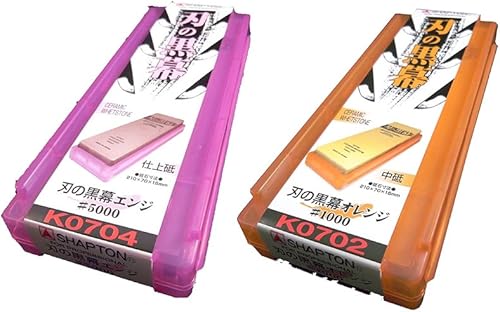
3. Shapton Kuromaku A-Set (#1000 + #5000)
3. Shapton’s #1000 and #5000 with cases that double as holders. No soaking means you can sharpen in a five-minute window.
👍 Pros & Cons
Pros
- Complete two-stone kit
- Cases double as holders
- No soaking wait
Cons
- No coarse stone for repairs
- Stock can be limited
📄 Detailed Review
- Stones: #1000 medium + #5000 fine
- Working surface: 210 x 70 x 15 mm each
- Holders: Ventilated cases double as holders
The A-set bundles the #1000 and #5000 Kuromaku stones with ventilated plastic boxes that serve as holders. Shapton notes the #1000 also covers coarse duties.
For many cooks this pair is the whole kit.

4. Suehiro Cerax 1000/3000 Combination Waterstone
4. A fast, durable Suehiro combination stone with a toothy #3000 finish that suits everyday kitchen knives.
👍 Pros & Cons
Pros
- Fast cutting and durable
- Excellent beginner grit pairing
Cons
- Shorter than 8 in. stones
- Soaking required
📄 Detailed Review
- Grits: #1000 / #3000
- Size: 7-1/4 x 2-1/2 in.
- Prep: Soak before use
Suehiro’s Cerax combination stone joins #1000 and #3000 in one 7-1/4 x 2-1/2 inch waterstone. Suehiro calls it fast cutting and durable.
The 1000/3000 pairing is ideal for home cooks who want a sharp but not over-polished edge.

5. MITSUMOTO SAKARI 1000/3000 Whetstone
5. A 1000/3000 white-corundum stone on a bamboo base with a non-slip pad, designed for 15–20° kitchen knives.
👍 Pros & Cons
Pros
- Bamboo base included
- Good beginner grit pairing
- Consistent slurry after soaking
Cons
- Soaking required
- Not a premium Japanese brand stone
📄 Detailed Review
- Grits: #1000 / #3000
- Abrasive: White corundum
- Base: Bamboo with non-slip pad
- Angle: Designed for 15°–20° work
This 1000/3000 stone uses white corundum and sits on a bamboo base with a non-slip pad.
It is a good-value first stone for 15–20 degree kitchen knives.

6. Shapton Kuromaku #1000 (K0702, Orange)
6. If you only buy one stone, Shapton’s orange #1000 cuts quickly enough to fix dull knives and still leaves a clean edge.
👍 Pros & Cons
Pros
- Cuts fast enough to double as a coarse stone
- Case doubles as a stone holder
- Hugely popular first stone
Cons
- Single grit only
- Thin compared with soaking stones
📄 Detailed Review
- Grit: #1000 (medium)
- Size: 210 x 70 x 15 mm
- Item: K0702
- Use: Rough or medium sharpening
Shapton describes the orange K0702 as a #1000 medium stone with enough bite to be used for rough or medium sharpening.
It is one of the most recommended first whetstones for kitchen knives because it cuts quickly and stays relatively flat.
How We Chose the Best Japanese Whetstone for Beginners
To choose the best Japanese whetstone for beginners, we prioritized grit pairing (a #1000 sharpening grit is essential), included bases or angle aids, soaking requirements and how quickly the stone dishes. We read beginner reviews specifically, looking for recurring complaints about wobble, slow cutting or confusing instructions.
Beginners should also build good hygiene habits: rinse and wash the knife after sharpening to remove metal particles and slurry, following USDA Food Safety and Inspection Service cleanliness guidance. Our full method is on the How We Test page.
Buying Guide: How to Choose the Best Japanese Whetstone for Beginners
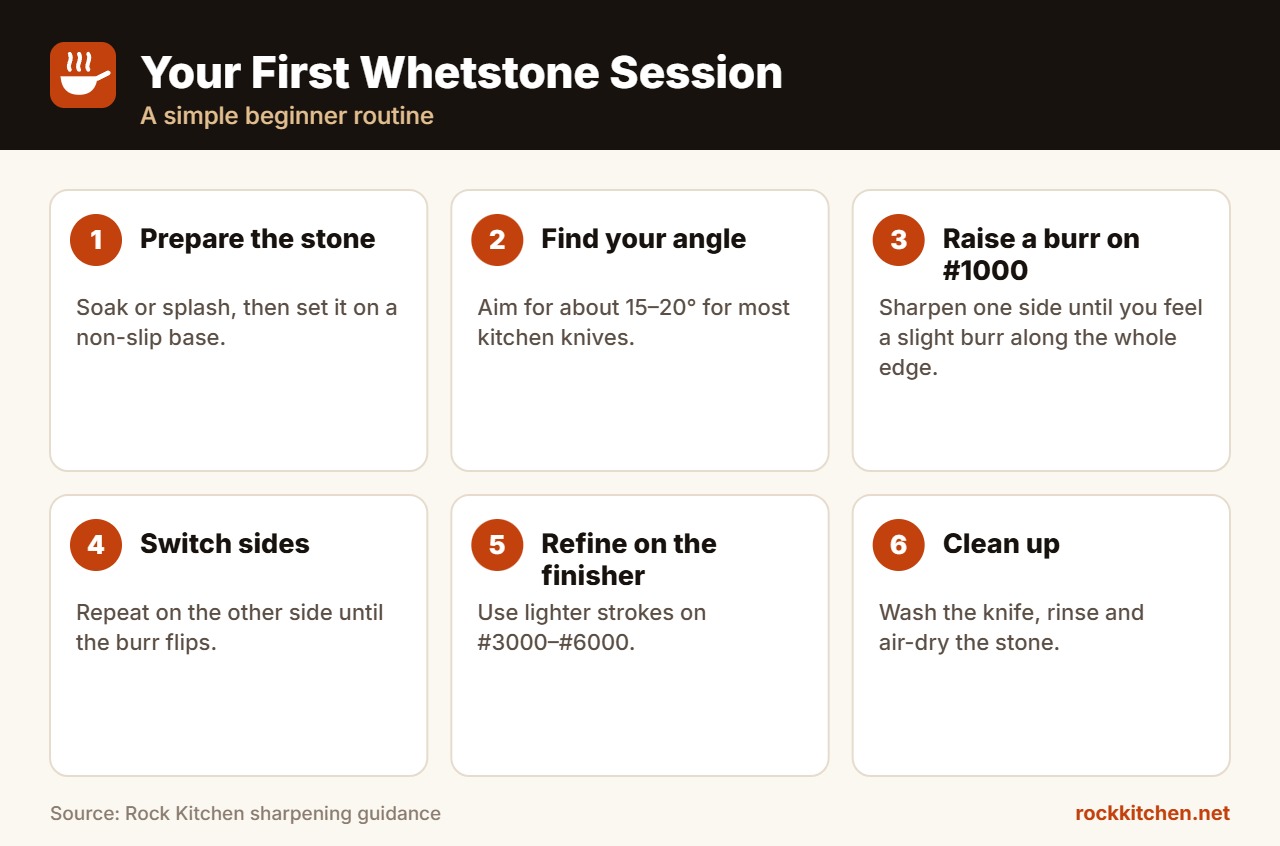
Start With #1000
A #1000 stone sharpens dull kitchen knives and teaches you to raise a burr. Without it, finishing stones are almost useless.
Add a Finisher Later
A #3000 gives a toothy, practical edge; #5000–#6000 gives a smoother polish. Combination stones save money while you learn.
Bases and Angle Aids
A stable base matters more than you think. Angle holders help at first, but practice freehand once you can hold 15–20° reliably.
Soaking vs. Splash-and-Go
Soaking stones need 10–15 minutes in water. Splash-and-go stones like Shapton are ready instantly, which helps if you sharpen in short sessions.
Plan for Flattening
All waterstones dish with use. Budget for a flattening plate once you sharpen regularly.
Beginner Mistakes to Avoid
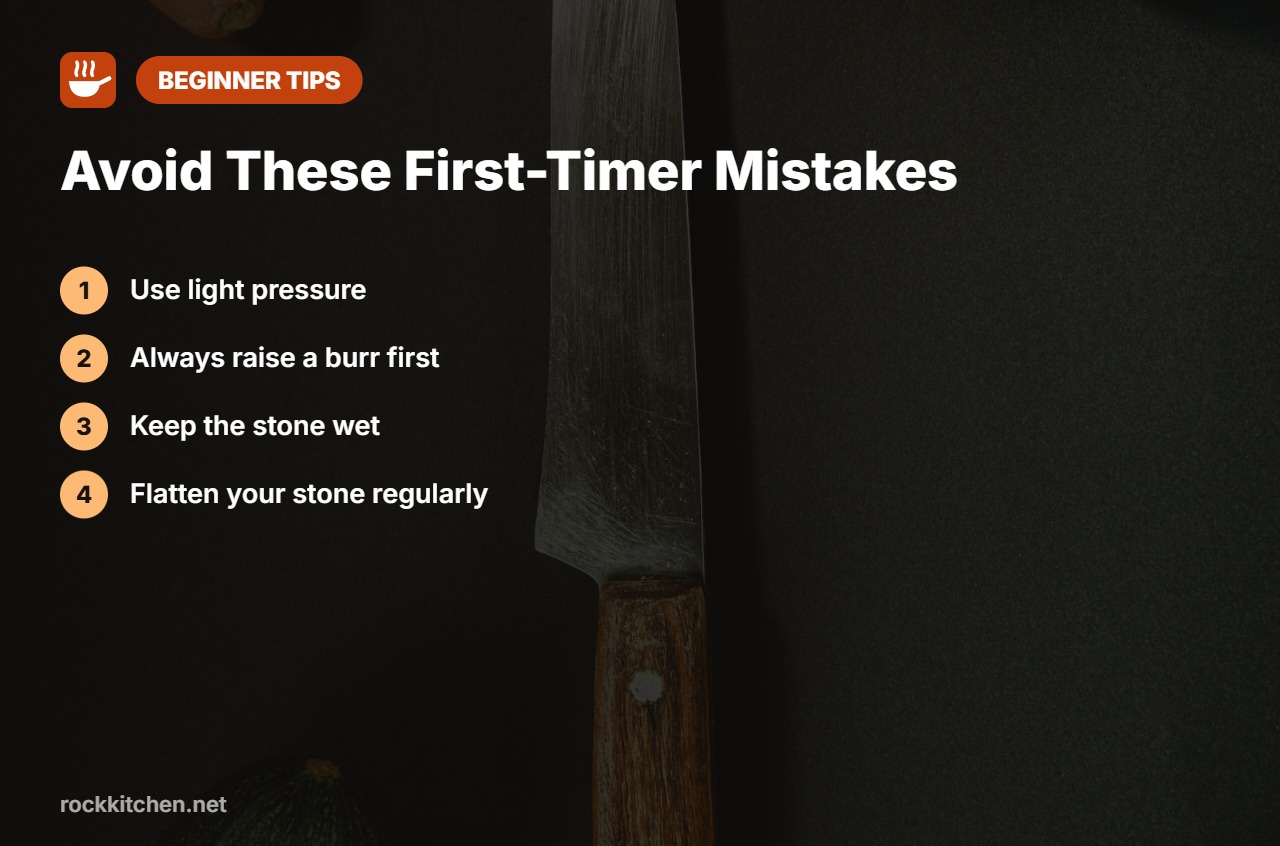
- Pressing too hard: let the stone do the work.
- Skipping the burr: no burr usually means the edge is not yet sharp.
- Letting a soaking stone dry out mid-session.
- Sharpening serrated knives on a flat stone.
- Never flattening the stone.
New to sharpening? These answers help you choose the best Japanese whetstone for beginners.
Frequently Asked Questions
What grit should a beginner start with?
Start with #1000. The best Japanese whetstone for beginners usually pairs #1000 with a #3000–#6000 finishing side.
Are angle guides worth it?
Yes for the first few weeks. They build consistency, but you will sharpen faster once you can hold the angle freehand.
How long do I soak a whetstone?
Soaking stones typically need 10–15 minutes, until bubbles stop. Splash-and-go stones need only a spray of water.
Can I sharpen German knives on Japanese stones?
Yes. Japanese whetstones work on German stainless knives; just use the angle your knife maker recommends.
Final Verdict
Our final pick for the best Japanese whetstone for beginners is the King KW65 1000/6000. Choose the King starter set if you want an angle holder, or the Shapton A-set to skip soaking.
Related Guides
Keep building your sharpening setup with these guides:
- Best Japanese Whetstone Brand 2026
- Best Diamond Sharpening Stone 2026
- How We Test and Research Kitchen Gear
- All Knife Sharpening Guides
Prices and availability change often. Check the current listing on Amazon before you buy.